

Project Overview
In the heart of Natick, Massachusetts, our clients were facing a frustrating issue: persistent drainage problems that transformed their backyard into a soggy, unusable space after every rainstorm. The property sits in a heavily wooded, natural environment, creating both beauty and complexity for landscape design. Our mission at Land Design Associates was to craft a long-term, sustainable drainage solution that blended seamlessly with the surrounding woodland — preserving the site’s natural charm while eliminating the chronic water issues.
Understanding the Challenge: Drainage in Natural Landscapes
Drainage issues in New England properties, especially those near wooded or low-lying areas, are increasingly common. Clay soils, compacted lawns, and uneven grading often lead to standing water or soil erosion after heavy rainfall.
In Natick, our client’s yard was affected by:
-
Poor soil percolation, which caused runoff and puddling after storms.
-
Surface water accumulation between the lawn and the wooded area.
-
A lack of defined flow paths for stormwater to move naturally.
Our goal wasn’t to install a utilitarian drainpipe or an unsightly trench. Instead, we wanted to integrate a natural drainage feature that enhanced the property’s appearance while resolving the problem once and for all.
The Design Solution: A 70-Foot Dry River Creek Bed
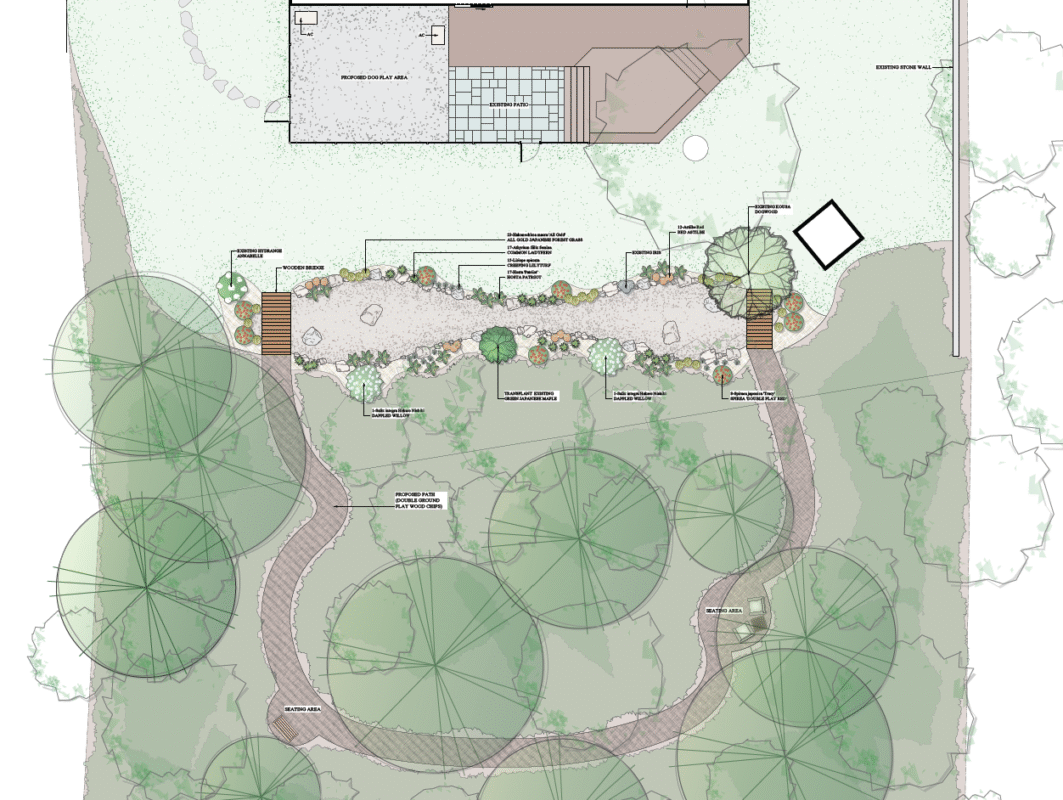
To bring both form and function into harmony, we designed a 70-foot-long by 15-foot-wide dry river creek bed that would mimic a natural watercourse — gently guiding stormwater through the yard and into the surrounding woodland.
Step 1: Site Excavation and Grading
Our team began by excavating the oversaturated material, removing compacted topsoil that prevented proper infiltration. We then re-graded the area to establish a subtle, natural flow channel, ensuring that stormwater would travel smoothly through the dry river bed without pooling.
Step 2: Structural Foundation
A solid foundation is essential for durability and proper drainage. We installed a cradle of crushed stone, providing both stability and permeability. This base layer allows stormwater to percolate through the soil naturally while preventing future erosion.
Step 3: River Rock and Boulder Placement
The surface of the creek bed was finished with ¾-inch river rock — chosen for its rounded, natural aesthetic and excellent drainage properties. We then placed large landscape boulders strategically throughout the feature to create the look of a true New England streambed. These boulders not only enhance visual realism but also help slow the flow of water, reducing erosion during intense rain events.
Crafting Functionality and Beauty: The Two Custom Bridges
Because the creek bed bisected the client’s path to their woods, we incorporated two custom-built wooden bridges, each handcrafted by our in-house carpenter. These bridges provide seamless access for both the homeowners and their dogs while maintaining the natural design language of the property.
-
Bridge 1: Positioned near the lawn’s edge for easy everyday access.
-
Bridge 2: Installed deeper along the wooded trail for a more rustic, immersive experience.
Both structures were designed with pressure-treated lumber and finished with a weather-resistant natural stain, ensuring they age gracefully alongside the landscape.
Native Plantings: Restoring Ecological Harmony
Our planting design was guided by one principle — enhance the natural aesthetic without forcing it. The site’s proximity to mature woodland provided a beautiful framework, so our goal was to choose native plants that would thrive under similar moisture conditions and blend seamlessly into the existing vegetation.
Native Plant Palette Highlights:
-
Ilex verticillata (Winterberry Holly): Adds vibrant red berries that attract birds through winter.
-
Carex pensylvanica (Pennsylvania Sedge): A graceful, low-maintenance groundcover ideal for shaded edges.
-
Clethra alnifolia (Summersweet): Known for fragrant summer blooms and tolerance for moist soils.
-
Aronia melanocarpa (Black Chokeberry): Offers spring flowers, fall color, and wildlife value.
-
Osmunda cinnamomea (Cinnamon Fern): Perfect for naturalized, woodland edges and wet conditions.
These species were selected not only for their ecological benefits but also for their textural contrast and seasonal interest, ensuring the creek bed would remain visually engaging year-round.
Results: Function Meets Form
Since completion, this Natick property has weathered several significant rain events, including spring downpours and fall nor’easters. The results speak for themselves — no flooding, no ponding, and no erosion.
Instead of a muddy, impassable yard, the homeowners now enjoy a beautiful natural feature that changes with the seasons — from sunlit stone ribbons in summer to glistening ice-lined formations in winter.
Why Dry River Beds Work So Well
Dry river beds are among the most effective and aesthetic solutions for managing stormwater in residential landscapes. They can serve as both a drainage system and a design statement, especially in properties where traditional solutions like French drains or catch basins would feel artificial.
Benefits of a Dry River Creek Bed
-
Prevents erosion by slowing and directing runoff.
-
Reduces standing water and improves soil drainage.
-
Enhances curb appeal with naturalistic design.
-
Supports native habitats by introducing micro-ecosystems.
-
Low maintenance once properly installed and planted.
Lessons Learned: Working with Nature, Not Against It
This Natick project highlights a core philosophy at Land Design Associates — the best landscapes cooperate with nature rather than trying to control it. Instead of forcing water underground, we allowed it to move visibly and naturally, turning a functional necessity into a sculptural centerpiece.
When designing for drainage, especially in wooded or sloped areas, we consider:
-
Topography and soil composition – these determine natural water flow.
-
Vegetation and canopy coverage – shade and root structure affect infiltration.
-
Hydrology patterns – understanding how stormwater interacts with site features prevents long-term issues.
By respecting these factors, we ensure every intervention feels authentic to the site — a philosophy that’s central to our landscape architectural design process.
The Land Design Associates Approach
At Land Design Associates, based in Walpole, Massachusetts, we specialize in landscape architectural design, construction, and maintenance throughout Greater Boston, including Natick, Needham, Wellesley, Newton, Westwood, and Dover.
Each project begins with a collaborative site consultation where we study your property’s unique character — soil, sunlight, drainage, and ecology — before developing a custom plan that enhances beauty, functionality, and sustainability.
We pride ourselves on combining:
-
Scientific expertise (horticulture, hydrology, and soil science)
-
Creative vision (fine art-driven design principles)
-
Craftsmanship (custom carpentry, masonry, and planting execution)
Sustainable Design in Action
This project also reflects our ongoing commitment to sustainability. By working with native species and using permeable materials, we reduce runoff, improve groundwater recharge, and minimize maintenance requirements.
Key sustainable strategies used:
-
Native and adaptive plantings that thrive with minimal irrigation.
-
Natural stone materials sourced locally to reduce carbon footprint.
-
Low-impact grading techniques that preserve root zones and existing trees.
-
Integrated stormwater management aligned with conservation best practices.
For Massachusetts homeowners, especially in towns like Natick, Sherborn, or Medfield, these strategies align with local stormwater bylaws and Conservation Commission guidelines, making them both environmentally and legally sound.
Client Feedback
The homeowners have shared that the transformation has not only solved their drainage issues but also elevated their outdoor experience. Their dogs now cross the bridges daily, and the couple frequently sits near the creek bed to enjoy the sound of wind through the pines — a space once avoided, now reclaimed as a sanctuary.
“We couldn’t be happier. It’s both beautiful and functional — like it’s always been part of the landscape.”
That kind of feedback reminds us why we do what we do — creating landscapes that connect people more deeply with their surroundings.
Ready to Transform Your Property?
If you’re struggling with drainage issues, erosion, or areas of your yard that feel unusable, a dry river creek bed might be the perfect solution. Our team of Certified Massachusetts Landscape Professionals (MLP-MCLP) can help design and build a system tailored to your property’s needs.
👉 See our work: https://landdesignassociates.com/featured-projects/
👉 We are certified Landscape Professionals: https://www.mlp-mclp.org/
👉 Schedule a consultation today: https://landdesignassociates.com/design-build-form/
Let’s transform your drainage challenge into a natural landscape feature you’ll love for decades.
Book a Free Consultation