

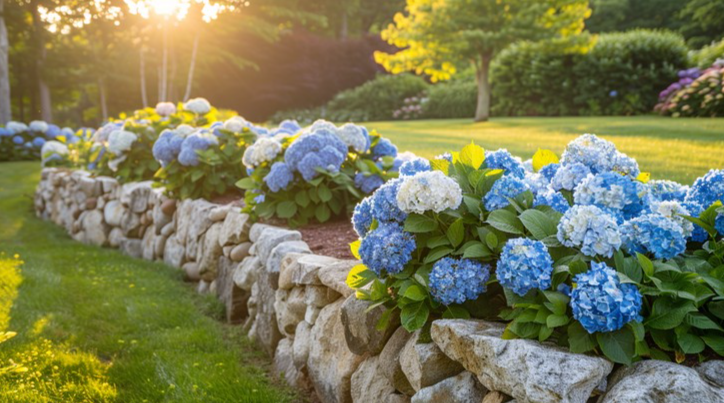
Mid-June on the South Shore means one thing for your landscape: the heat is here, and how you water over the next six weeks will determine whether your lawn and gardens thrive through summer or limp into September looking exhausted. Smart watering strategies for mid-June aren’t complicated, but they do require a shift in thinking — from convenience-based watering to plant-based watering. At Land Design Associates, we’ve helped homeowners in Hingham, Cohasset, Duxbury, and across the South Shore keep their landscapes healthy through even the hottest summers, and the principles are simpler than most people expect.
Why Mid-June Is the Critical Watering Window
June is the inflection point. Soil temperatures have finally warmed, plants are in active growth, and the long, sun-saturated days of midsummer are beginning. For cool-season grasses like the tall fescue and Kentucky bluegrass common on South Shore lawns, this is also the beginning of heat stress season. If you establish good watering habits now, your lawn and garden will build the root depth and resilience to carry them through July and August without significant damage.
Get it wrong — water too shallowly, water at the wrong time, or ignore the signals your plants are sending — and you’ll spend the rest of summer trying to recover from a deficit that started right here, in June. The good news is that smart watering isn’t about watering more. It’s about watering smarter.
The Golden Rule: When to Water on the South Shore
The single most important watering decision you make every day is timing. Water between 5 and 8 in the morning. Full stop.
Early morning watering does three things that no other watering window can match. First, it minimizes evaporation — temperatures are low, wind is calm, and water soaks into the soil rather than disappearing into the air. On a hot June day in Hingham or Cohasset, midday watering can lose 30 to 50 percent of its water to evaporation before it ever reaches roots. Second, morning watering allows foliage to dry completely before nightfall, dramatically reducing the risk of fungal diseases like powdery mildew, brown patch, and dollar spot that thrive in wet overnight conditions. Third, it puts water in the soil at exactly the moment plants begin their active growing and transpiring day — the biological equivalent of a good breakfast.
Evening watering — specifically after 6 pm — is acceptable if morning watering is genuinely impossible. What you want to avoid entirely is the midday window between 10 am and 5 pm, when water evaporates almost as fast as it falls, and the late-night window that keeps foliage wet through the darkness.
How Much Water Does Your South Shore Lawn Actually Need?
Most South Shore lawns need approximately one inch of water per week during June, delivered in two or three sessions rather than daily. This sounds simple, but the most common mistake we see is daily light watering that never penetrates more than an inch below the surface. Roots follow water. If your watering only wets the top inch of soil, your lawn will develop a shallow, heat-vulnerable root system that bakes the moment temperatures spike.
The screwdriver test is the most reliable real-world check: push a long screwdriver or soil probe straight into the ground. After a proper watering, it should slide through six inches with minimal resistance. If it stops at two inches, your watering isn’t deep enough. If the soil is saturated and muddy, you’re overwatering.
Invest in an inexpensive rain gauge — or simply place a straight-sided tuna can on the lawn — to measure how much your sprinkler or irrigation system actually delivers per session. Calibration takes twenty minutes and will change how you water for the rest of the season.
Smart Watering for Hingham Gardens
Hingham’s landscape character — mature tree canopies, established perennial borders, a mix of clay-influenced and sandy loam soils — creates some specific watering considerations. Areas under mature trees are often chronically dry in June because tree roots are efficient competitors for soil moisture. If you have established garden beds under or near large oaks, maples, or beeches, plan to water those areas more frequently and deeply than open lawn areas.
Hingham’s harbor-adjacent properties also benefit from slightly elevated humidity, which can reduce some heat stress — but don’t let that lull you into under-watering. The key for Hingham gardens in mid-June is consistency. A reliable early-morning watering schedule, combined with two to three inches of mulch over all garden beds, will carry most Hingham landscapes through peak summer with minimal intervention.
Perennial borders in Hingham are best watered at the base using drip irrigation or a soaker hose rather than overhead sprinklers. Overhead watering on established perennials encourages fungal disease and can damage flowers. Drip systems deliver water precisely to root zones and use significantly less water than overhead irrigation — a meaningful consideration as South Shore communities increasingly manage summer water demand.
Coastal Watering Strategies for Cohasset
Cohasset’s coastal landscape presents unique challenges. Salt air, wind exposure, and the thin, rocky, often rapidly-draining soils found near the ledge mean that irrigation schedules that work inland need to be recalibrated for Cohasset properties.
The primary issue is drainage. Water applied to a rocky or gravelly coastal soil in Cohasset moves through the root zone quickly — faster than in heavier inland soils. This is actually good news for root health (no waterlogging) but means plants need more frequent replenishment. Coastal gardens in Cohasset often benefit from watering three times per week rather than twice, particularly during dry June stretches.
The other Cohasset-specific strategy is native plant selection. Our most drought-resilient Cohasset projects rely heavily on plants that evolved alongside the Massachusetts coast — rugosa rose, bayberry, beach plum, little bluestem, seaside goldenrod, and inkberry. Once established, these plants require dramatically less supplemental irrigation than conventional landscape plants, making them the smartest long-term investment for coastal South Shore gardeners.
Duxbury Landscapes: Working With Sandy Soils
If you garden in Duxbury, you’re likely already familiar with the challenge of sandy soil. The barrier beach geology that makes Duxbury so visually spectacular also means that garden soils drain fast — sometimes too fast. Water applied in the evening can be largely gone from the root zone by morning.
The solution for Duxbury gardeners is twofold. First, amend soil with generous amounts of compost — not just at planting time, but as an annual top-dressing on all garden beds. Compost dramatically improves sandy soil’s water-holding capacity. Second, mulch heavily. A three-to-four-inch layer of shredded bark, wood chip, or pine straw over Duxbury garden beds acts as a sponge, slowing evaporation and keeping root zones measurably cooler through the hottest June days.
Duxbury lawns on sandy soils may need watering every other day during hot, dry June stretches — more frequently than the standard twice-weekly recommendation for heavier soils. A smart irrigation controller that reads soil moisture rather than running on a fixed schedule is particularly valuable on Duxbury properties.
The Cycle-and-Soak Method
Cycle and soak is the single most effective watering technique for slopes, compacted soils, and any area prone to runoff — which describes a significant portion of South Shore residential landscapes.
The method is straightforward: run your irrigation zone for ten minutes, then pause for thirty minutes to allow the water to infiltrate the soil, then run again for ten minutes. This two-cycle approach delivers the same total water volume as a single twenty-minute run but eliminates the surface runoff that carries water (and nutrients) away before it can reach roots. On Hingham, Cohasset, and Duxbury properties with any grade at all, cycle-and-soak can increase effective water delivery to roots by twenty to forty percent with zero additional water use.
Most modern smart irrigation controllers — and even many basic timer-based systems — can be programmed to run cycle-and-soak schedules automatically.
Mulching: Your Best Weapon Against Heat
No single intervention does more for a South Shore landscape in June than mulch. A two-to-four-inch layer of organic mulch over all garden beds and around trees reduces soil moisture evaporation by twenty-five to fifty percent, keeps root zones ten to fifteen degrees cooler than bare soil, suppresses weeds that compete for water, and gradually improves soil structure as it breaks down.
Use shredded bark, wood chip, or pine straw. Avoid dyed mulches, which contribute nothing biologically and tend to fade quickly in coastal sun. Keep mulch pulled back a few inches from the base of trees and shrubs — mulch piled against trunks creates conditions for rot and pest damage, a common mistake we see on South Shore properties.
If you mulch once in late May or early June and maintain depth through the season, you can meaningfully reduce your irrigation frequency and your water bill simultaneously.
Smart Irrigation Technology
A weather-based smart irrigation controller is one of the highest-return investments available to South Shore homeowners. These controllers connect to local weather data and automatically skip watering cycles when rain is forecast, adjust run times based on evapotranspiration rates, and send alerts when system problems are detected. On a typical South Shore residential landscape, a smart controller can reduce irrigation water use by twenty to fifty percent compared to a fixed-schedule timer.
Drip irrigation systems for garden beds offer another level of efficiency. Where conventional sprinklers operate at fifty to seventy percent efficiency (with the remainder lost to evaporation and overspray), well-designed drip systems routinely achieve ninety percent efficiency. For clients in Hingham, Cohasset, and Duxbury looking to maintain beautiful gardens with minimal environmental impact, drip irrigation is increasingly the standard we recommend and install.
Signs Your Plants Are Telling You Something
Learn to read your landscape. The most reliable irrigation data comes not from a schedule or a timer but from the plants themselves. In mid-June, watch for these signals:
Wilting before 10 am, when temperatures are still relatively cool, indicates genuine water deficit — not just heat stress. Footprints that stay visible in lawn grass rather than springing back are a classic sign of drought stress. Brown or bleached leaf tips on ornamental grasses and perennials indicate heat and moisture stress in combination. Soil that cracks or pulls away from bed edges is telling you it is seriously dry below the surface.
On the flip side, yellowing leaves, persistently soft or spongy soil, fungal spotting on foliage, and a musty smell from garden beds are signs of overwatering — a surprisingly common problem in June when homeowners are anxious about the approaching heat and water too frequently.
The goal is balance. Deep, infrequent watering that keeps soil consistently moist six inches down — not wet, not dry — is the target for every South Shore landscape through the summer months.
Land Design Associates in Walpole, MA provides landscape design, planting design, and garden consultation services for homeowners in Hingham, Cohasset, Duxbury, and the South Shore. If your landscape needs a full assessment going into summer — or if you’re thinking about a smart irrigation upgrade — contact us to schedule a site visit.
For additional guidance on summer lawn care for New England, the UMass Extension Turf Program is an excellent resource.
Frequently Asked Questions
When is the best time to water my lawn on the South Shore of Massachusetts? The best time to water is between 5 and 8 am. Early morning watering reduces evaporation, prevents fungal disease, and ensures water reaches the root zone before mid-June heat peaks on the South Shore.
How often should I water my garden in Hingham, Cohasset, or Duxbury in June? Most South Shore lawns need watering two to three times per week in June, delivering about one inch of water total. Gardens and perennial beds benefit from deep, infrequent watering rather than daily light irrigation.
Does coastal soil on the South Shore affect how I should water? Yes. Sandy and gravelly soils common in Duxbury and Cohasset drain quickly, meaning plants may need slightly more frequent watering than inland gardens. Mulching deeply helps retain moisture significantly.
What is the cycle-and-soak watering method? Cycle and soak means running irrigation for ten minutes, pausing thirty minutes to let water absorb, then repeating. This prevents runoff on slopes and compacted soils common in South Shore landscapes.
Can Land Design Associates help design an irrigation system for my South Shore property? Yes. Land Design Associates in Walpole designs smart irrigation systems for properties in Hingham, Cohasset, Duxbury, and across the South Shore, including drip systems, smart controllers, and rain sensors.
Schedule Your Landscape Design Consultation Today
If you are planning a project and need landscape design in Walpole, MA or landscape design in Hingham, Duxbury and Cohasset, MA, working with the right team makes all the difference.
Land Design Associates is ready to help you design and build an outdoor space that is functional, durable, and built around your lifestyle.
Start with a design consultation:
https://landdesignassociates.com/design-build-form/
Or explore our work here:
https://landdesignassociates.com/featured-projects/