

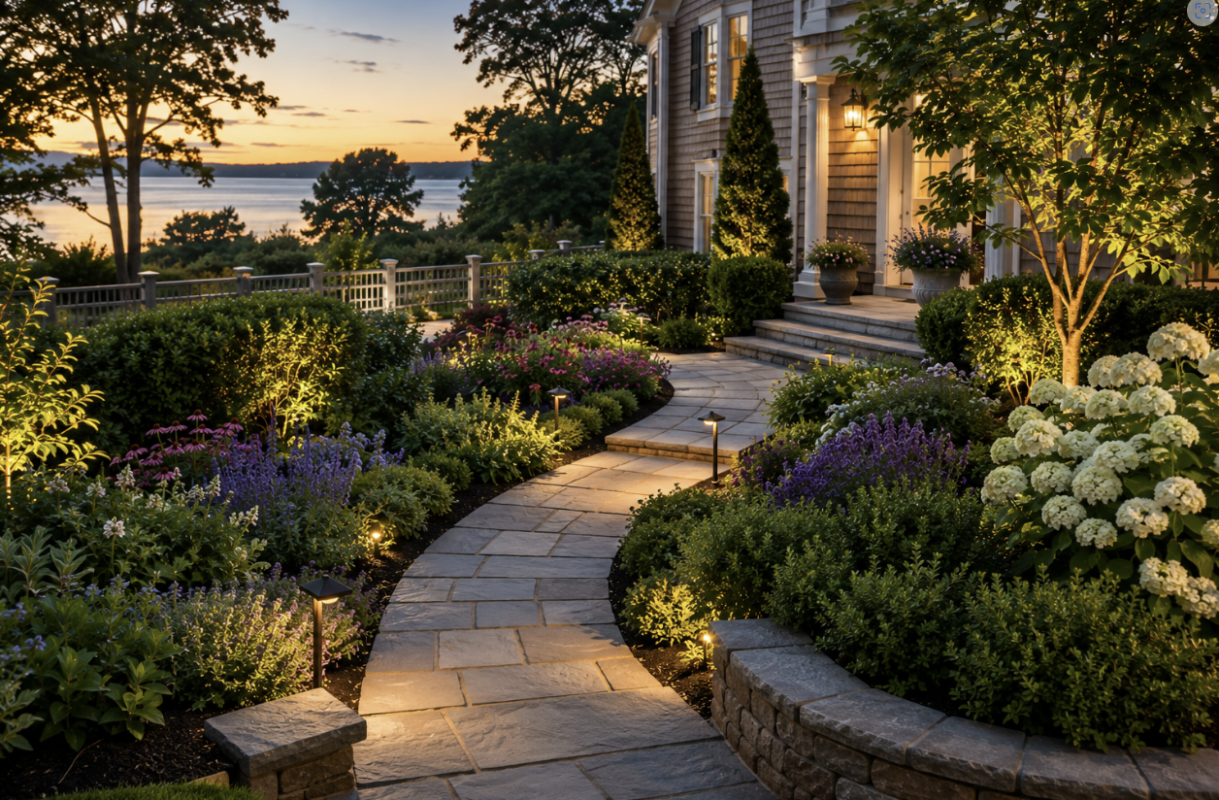
June is the month South Shore gardeners wait all year for. After the slow green build of May, the landscape finally commits — borders fill out, shrubs reach peak bloom, and the combination of long days, warming soil, and the first real heat of summer pushes everything into full expression simultaneously. If you’ve ever driven through Hingham Center when the mountain laurels are at their peak, or walked the coastal paths near Cohasset when the rugosa roses are in flower, you understand exactly what we mean. June on the South Shore is extraordinary.
At Land Design Associates in Walpole, we spend June doing two things: admiring what’s blooming in the landscapes we design for clients across Hingham, Cohasset, Duxbury, and the South Shore, and making notes on what to add to future designs. This month’s plant spotlight is our curated list of what’s performing beautifully right now — the plants worth knowing, planting, and celebrating in a coastal Massachusetts garden.
Catmint (Nepeta): The Workhorse of the June Border
If we had to choose one plant that defines the look and feel of a well-designed South Shore perennial border in June, it would be catmint. The long, arching stems covered in small lavender-blue flowers are unmistakable, and the soft gray-green foliage provides contrast and texture long after the bloom period ends.
Catmint is extraordinary not because it is flashy — it isn’t — but because it does so many things exceptionally well. It blooms prolifically from late May through June, then again in late summer if cut back after the first flush. It is drought tolerant once established, which matters enormously on the sandy coastal soils of Duxbury and Cohasset. It is largely unbothered by deer, which is an increasingly significant consideration for South Shore properties. It cascades beautifully over the edges of stone walls and patio borders. And it attracts bees and other pollinators in extraordinary numbers.
Our go-to varieties for South Shore landscapes include ‘Walker’s Low’ — which, despite the name, grows two to three feet tall and wide and creates a spectacular billowing mass effect — and ‘Six Hills Giant’ for larger borders where volume and impact are the priority. Both perform admirably in the salt air and coastal wind conditions of Hingham, Cohasset, and Duxbury.
Plant catmint in full sun with good drainage. It will forgive almost everything else.
Mountain Laurel: New England’s Native Crown Jewel
Mountain laurel is technically peaking in late May and early June across Massachusetts, but on the South Shore, where the season runs slightly warmer, it often holds its bloom well into the second week of June. When it’s at its best, there is nothing more stunning in the New England landscape.
This is a true Massachusetts native — found naturally in woodland edges, rocky hillsides, and the transitional zones between forest and open land that characterize much of the inland portions of Hingham, Duxbury, and the South Shore’s back roads. The clusters of white to pale pink buds open into intricate, geometrically perfect flowers that look almost too refined to belong to a wild shrub. They do.
Mountain laurel thrives in the partial shade of a woodland edge or beneath a high tree canopy. It requires acidic, well-drained soil — conditions that are extremely common on the South Shore, where sandy and loamy soils naturally lean acidic. It is slow-growing and long-lived, meaning a well-sited mountain laurel planted today will be a significant landscape feature within five years and a mature specimen worthy of a garden focal point within fifteen.
For South Shore gardeners with partially shaded woodland areas, a mass planting of mountain laurel is one of the most beautiful and ecologically appropriate choices available. It supports native pollinators, requires minimal maintenance once established, and delivers a bloom show that stops people in their tracks every June.
Rugosa Rose: The True Coastal Classic
No plant says South Shore summer quite like the rugosa rose. Walk any coastal path in Cohasset or Duxbury in early June and you will encounter it — sprawling over rocky outcroppings, threading through chain-link fences, perfuming the salt air with one of the most evocative scents in all of horticulture.
Rugosa rose is not a delicate plant. It is tough, insistent, and spectacularly beautiful in the way that only truly coastal plants can be. The flowers — large, single or semi-double blooms in deep pink, pale pink, or white depending on the cultivar — appear over a long season from June through August. The hips that follow are among the largest and most ornamental of any rose species, turning the plant into an autumn focal point long after bloom ends.
In designed landscapes, rugosa rose performs best when it has room to express its naturally arching, spreading habit. It makes an exceptional informal hedge, a textural mass planting at the edge of a property, or a wild-looking element in a coastal naturalistic garden. It is virtually maintenance-free — it does not need deadheading, spraying, or fussing — which makes it one of our most-recommended plants for South Shore properties where low-maintenance performance is a priority.
Selected cultivars we specify regularly include ‘Hansa’ (deep pink, intensely fragrant), ‘Blanc Double de Coubert’ (white, fragrant, semi-double), and the straight species Rosa rugosa for maximum wildlife value and coastal toughness.
Baptisia (False Indigo): The Native You Should Know
Baptisia australis is one of those plants that landscape designers love and the general public is only now beginning to discover. If you are not growing it, you should be — and June is the moment that explains exactly why.
In full June bloom, baptisia produces tall, stiff spikes covered in indigo-blue flowers that recall lupines but with a cleaner, more architectural quality. The plant itself is a substantial clump-forming perennial — three to four feet tall and wide at maturity — with blue-green foliage that remains attractive and dense all season long, even after the bloom has faded to the dramatic inflated seed pods that rattle satisfyingly in autumn wind.
Baptisia is a native plant with deep roots — literally. The taproot system goes down several feet into the soil, making it extremely drought tolerant once established and an excellent choice for the fast-draining soils common in Duxbury and the sandy margins of Cohasset properties. It is long-lived, largely pest and disease free, and unbothered by deer. Once established, a baptisia clump will be with you for decades.
The one thing to know: baptisia is slow to establish. It may look modest in its first and second years. By year three, it begins to fill out. By year five, it is spectacular. Plant it with that timeline in mind, and it will reward patience in ways that few other perennials can match.
Allium: Drama on a Stem
If you want to understand why allium has become one of the most talked-about plants in contemporary garden design, go find a ‘Globemaster’ or ‘Ambassador’ allium in full bloom in the first week of June. The eight-to-ten-inch diameter spherical flower heads on tall, clean stems — rising above lower-growing companion plants in saturated purple-violet — create a visual effect that is simultaneously playful and sophisticated.
Alliums are ornamental onions, and they bring to the garden border the qualities that make their vegetable relatives so useful in the kitchen: absolute reliability, ease of culture, and a long season of interest. The bloom period peaks in early to mid-June on the South Shore. After bloom fades, the seed heads dry in place and continue to provide architectural interest through summer and into fall.
Deer do not eat alliums. This makes them particularly valuable in Hingham and Duxbury, where deer pressure on residential gardens has intensified significantly in recent years. Mass plantings of allium in the mid-border, combined with catmint and salvia at the front, create a June display that is both beautiful and genuinely deer-resistant — a combination that has become something of a signature in our South Shore planting designs.
Salvia ‘May Night’: The Pollinator’s Favorite
Salvia nemorosa ‘May Night’ blooms in May and — confusingly, despite its name — continues blooming well into June on the South Shore, where the slightly moderated coastal climate extends the performance of early-summer plants. The deep violet-indigo flower spikes are among the most intensely colored things in the June garden, and they draw pollinators with a consistency that has made this plant a keystone species in pollinator-focused landscape design.
‘May Night’ is compact — twelve to eighteen inches tall — which makes it ideal at the front of the border, along patio edges, or as a mass groundcover element in a larger planting. It combines beautifully with catmint, allium, and the silvery foliage of artemisia or lamb’s ear. Cut it back hard after the first flush of bloom and it will typically rebloom in late July or August.
Siberian Iris: Early June Elegance
The Siberian iris peaks slightly earlier than most of this month’s spotlight plants — often in the last week of May through the first two weeks of June — but it earns its place on this list because few plants offer its combination of refined beauty, toughness, and landscape versatility.
The flowers — in shades of purple, blue-violet, white, and yellow depending on cultivar — have an almost orchid-like refinement that looks extraordinary against the casual richness of a naturalistic South Shore planting. After bloom, the upright, grass-like foliage remains clean and attractive through the entire growing season, providing strong vertical texture in the border.
Siberian iris tolerates wetter conditions than most perennials — an important characteristic for some of the lower-lying gardens and coastal margin properties in Duxbury and along the South Shore’s estuaries. It is also fully winter hardy, disease resistant, and virtually maintenance free once established.
Hardy Geranium ‘Rozanne’: The Season-Long Performer
In a post about what’s blooming in June, ‘Rozanne’ deserves special mention because it is one of the few plants that genuinely blooms from June through frost without a significant rest period. The flowers are a clear blue-violet with a white center — not flashy, but relentlessly cheerful — and the habit is a loose, spreading mound that works beautifully as a groundcover, a border filler, or a cascading element over low walls.
‘Rozanne’ has become one of the most-planted perennials in the world for good reason. It is easy, attractive, adaptable to a wide range of coastal soil conditions, and virtually never needs dividing or fussing. For South Shore clients who want continuous color from early summer through October with minimal maintenance commitment, ‘Rozanne’ is almost always on our plant list.
Planting for June: What Hingham, Cohasset & Duxbury Gardens Need
Understanding the specific conditions of South Shore gardens is essential to getting the most from June-blooming plants. Hingham’s heavier loam soils and partially shaded woodland lots favor mountain laurel, Siberian iris, and baptisia. Cohasset’s rocky, lean coastal soils suit rugosa rose, catmint, and allium exceptionally well. Duxbury’s fast-draining sandy soils are ideal for salvia, catmint, and drought-tolerant natives like baptisia and seaside goldenrod.
Across all three communities, salt air tolerance is a factor worth considering even for properties set back from the immediate shoreline. Plants stressed by salt exposure show leaf scorch and reduced vigor — subtle signs that the planting palette needs refinement. All of the plants featured in this spotlight have demonstrated reliable salt tolerance in our South Shore projects.
For more on selecting plants appropriate to your specific site conditions, the UMass Extension Plant Diagnostic Laboratory is an excellent resource for Massachusetts gardeners.
How to Use the June Plant Spotlight in Your Own Garden
The plants featured here are not just beautiful — they are practical. Every one of them has been chosen based on field performance in South Shore landscapes, proven reliability in coastal Massachusetts conditions, and the kind of low-maintenance longevity that makes a planting investment worthwhile.
If your garden is missing the blue-purple punch of catmint and salvia, the architectural drama of allium, or the native soul of mountain laurel and baptisia, June is the moment to make note. Fall planting — September and October — is the ideal time to install most of these plants, giving them a full season of root establishment before they face their first South Shore summer.
Land Design Associates provides planting design services for residential clients throughout Hingham, Cohasset, Duxbury, and the South Shore. If you are thinking about redesigning an existing border, adding pollinator-friendly plantings, or building a new garden from scratch, we would love to help. Contact us to schedule a design consultation.
Frequently Asked Questions
What plants are blooming in June in Massachusetts? In June, Massachusetts gardens feature mountain laurel, catmint, Siberian iris, baptisia (false indigo), rugosa rose, allium, salvia, and hardy geraniums. On the South Shore, coastal-tolerant natives like beach rose, bayberry, and seaside goldenrod also come into their own in early summer.
What are the best plants for a coastal garden in Hingham, Cohasset, or Duxbury? The best plants for South Shore coastal gardens include rugosa rose, beach plum, bayberry, little bluestem grass, catmint, baptisia, and seaside goldenrod. These natives and near-natives thrive in salt air, sandy soils, and coastal wind conditions common in Hingham, Cohasset, and Duxbury, MA.
What perennials bloom in June in New England? June-blooming perennials for New England gardens include catmint (Nepeta), salvia ‘May Night’, Siberian iris, baptisia, hardy geranium ‘Rozanne’, allium, peonies, and astilbe. Many of these are also excellent performers in the coastal conditions of the South Shore.
Which June-blooming plants attract pollinators on the South Shore? Top pollinator plants blooming in June on the South Shore include catmint, salvia, baptisia, allium, rugosa rose, and mountain laurel. These plants support native bees, bumblebees, and butterflies and are well-suited to the coastal Massachusetts climate in Hingham, Cohasset, and Duxbury.
Can Land Design Associates help me choose plants for my South Shore garden? Yes. Land Design Associates in Walpole MA provides planting design services for residential clients throughout Hingham, Cohasset, Duxbury, and the South Shore. We specialize in plant palettes tailored to coastal New England conditions — selecting plants that perform beautifully season after season with minimal maintenance.
Schedule Your Landscape Design Consultation Today
If you are planning a project and need landscape design in Walpole, MA or landscape design in Hingham, Duxbury and Cohasset, MA, working with the right team makes all the difference.
Land Design Associates is ready to help you design and build an outdoor space that is functional, durable, and built around your lifestyle.
Start with a design consultation:
https://landdesignassociates.com/design-build-form/
Or explore our work here:
https://landdesignassociates.com/featured-projects/