

If you live on the South Shore of Massachusetts, you know the landscape here has a particular character. Whether you’re in Hingham, Cohasset, or Duxbury, properties tend to sit within or near natural woodland — mature trees, native understory, the quiet layering of a New England habitat that took decades to develop.
So when a homeowner approached us with a familiar problem — an unsightly neighboring yard that needed to be screened from view — we knew the usual solution wasn’t going to cut it.
A rigid row of identical evergreens planted at equal spacing would do the job, technically. But it would also stick out like a wall against everything natural around it. Our client wasn’t asking for a wall. They were asking for privacy that felt like it belonged.
That’s the kind of challenge Land Design Associates was built for.
The problem with traditional privacy hedges
The most common approach to evergreen privacy screening is simple: pick one species, plant it in a straight line, space it evenly, repeat. Arborvitae ‘Green Giant’ is probably the most overused plant on the South Shore for exactly this reason. It’s fast-growing, it’s dense, and it works.
But it also looks like a green wall. Especially on properties adjacent to natural wooded areas — which describes a significant portion of residential lots in Hingham, Cohasset, and Duxbury — a monoculture hedge row can feel completely disconnected from its surroundings.
Beyond aesthetics, monoculture plantings carry real risk. A single disease or pest can take out an entire screen. In recent years, arborvitae plantations across New England have faced serious pressure from deer browse and bagworm infestations. When every plant is the same, every plant is equally vulnerable.
A naturalized, mixed-species approach solves both problems at once.
What “naturalized” evergreen screening actually means
When we use the word naturalized, we mean a planting that mimics the organic patterns found in nature rather than imposing a geometric, human-made structure on the landscape.
In a natural woodland edge — the kind you’d find throughout the South Shore — plants don’t grow in straight lines. They grow in clusters and drifts. Taller canopy species reach upward while mid-story shrubs fill in beneath. Ground-level plants spread laterally. Gaps appear, then close. The whole system creates depth, variation, and layering that feels alive.
Naturalized evergreen screening applies those same principles to a functional privacy planting. Instead of one species in a row, you get:
- Multiple evergreen species with varying heights, textures, and growth habits
- Staggered positioning rather than a uniform line
- Layered structure — taller background trees, mid-height shrubs, and lower understory plants working together
- Intentional variation in spacing that mimics natural plant communities
- Native and regionally appropriate species that support local wildlife and require less maintenance
The result is a screen that works just as well — often better — than a traditional hedge, but reads as a natural extension of the existing landscape rather than a planted barrier.
Our process: from sightlines to finished screen
Every privacy screening project we take on at Land Design Associates starts the same way: with a site analysis that goes well beyond measuring the fence line.
Step 1: Evaluate sightlines from multiple angles. We walk the property from the homeowner’s primary viewing positions — windows, outdoor living areas, the driveway — and identify exactly where the screening needs to perform. We also walk the neighboring side to understand what’s visible and at what height.
Step 2: Assess existing conditions. Soil, drainage, sun exposure, and existing vegetation all factor into species selection. The South Shore’s mix of sandy coastal soils near Cohasset and Duxbury and the heavier soils found inland toward Hingham call for different plant palettes. Getting this right means lower maintenance and better long-term performance.
Step 3: Design the planting as a composition, not a line. Rather than plotting plants on a grid, we design the screen the way a landscape painter would approach a canvas — thinking about depth, silhouette, texture variation, and how the planting will look across seasons and across years.
Step 4: Install with long-term growth in mind. Proper planting depth, backfill, and post-installation watering are non-negotiable. We also factor in the mature size of each species so the screen fills in appropriately without becoming overcrowded or requiring constant pruning to stay manageable.
Species we commonly use for naturalized screening on the South Shore
South Shore homeowners in Hingham, Cohasset, and Duxbury benefit from a wide palette of evergreen species that perform well in coastal New England conditions. Here are our go-to choices organized by layer:
Canopy layer — 15–40 ft at maturity
- Eastern White Pine (Pinus strobus) — fast-growing, soft texture, excellent wind screening
- Norway Spruce (Picea abies) — dense, dark green, strong structure
- White Spruce (Picea glauca) — excellent cold and wind tolerance
Mid-story layer — 8–20 ft at maturity
- Emerald Green Arborvitae (Thuja occidentalis ‘Smaragd’) — dense, columnar, reliable
- Nellie Stevens Holly (Ilex × ‘Nellie R. Stevens’) — broadleaf evergreen with seasonal berry interest
- American Holly (Ilex opaca) — native, wildlife-friendly, beautiful structure
Understory / shrub layer — 3–8 ft at maturity
- Inkberry (Ilex glabra) — native, deer-resistant, excellent filler
- Mountain Laurel (Kalmia latifolia) — native broadleaf evergreen with stunning late spring flowers
- Leucothoe (Leucothoe fontanesiana) — graceful arching habit, excellent shade tolerance
Combining species across these three layers creates a planting that screens at every height while providing visual interest, wildlife habitat, and long-term resilience.
Why South Shore homeowners choose a naturalized approach
We’ve completed privacy screening projects across the South Shore — from waterfront estates in Cohasset to wooded residential lots in Duxbury and established neighborhoods in Hingham — and the feedback we consistently hear is the same: it looks like it was always there.
That’s the goal. Not a green wall. Not a formal hedge. A living, layered planting that enhances the property’s natural character while delivering the privacy the homeowner needs.
Beyond aesthetics, our South Shore clients appreciate several practical advantages of the naturalized approach:
- Resilience: Mixed-species plantings are far less vulnerable to pests, disease, and weather events than monoculture hedges.
- Lower maintenance: Correctly selected and spaced plants that suit the site conditions require minimal intervention once established.
- Wildlife value: Native species support pollinators, birds, and beneficial insects — an increasing priority for homeowners across Hingham, Cohasset, and Duxbury.
- Year-round beauty: A well-designed evergreen screen looks intentional and beautiful in every season, not just when leaves are on the trees.
The project that inspired this post
The case study that prompted this article involved a repeat client — one of the highest compliments a landscape contractor can receive. After a successful first installation, this homeowner trusted us again with a privacy challenge along a property edge adjacent to a neighbor’s unruly yard.
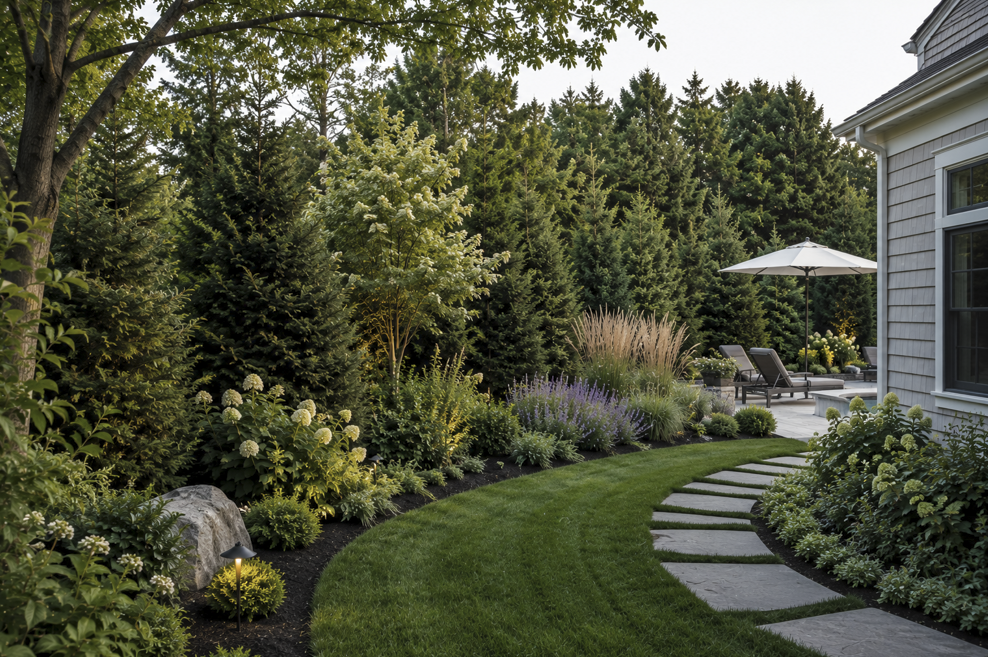
Our solution used a staggered, drift-style evergreen planting incorporating multiple species selected for both screening effectiveness and natural appearance. The placement of each specimen was guided by sightlines from the homeowner’s primary outdoor living areas and interior windows.
The finished planting transformed the property edge from a source of frustration into one of its most attractive features — a layered, woodland-inspired screen that delivers complete privacy while feeling like a natural part of the South Shore landscape.
The homeowner was thrilled. We were, too.
Ready for a privacy screen that looks like it belongs?
If you’re a homeowner in Hingham, Cohasset, Duxbury, or anywhere on the South Shore looking for privacy screening that doesn’t look like a planted wall, Land Design Associates is ready to help.
We design and install naturalized evergreen screens that deliver real, year-round privacy while enhancing the natural character of your property. Every project starts with a site-specific evaluation and a design built around your landscape, your sightlines, and your long-term goals.
Contact Land Design Associates today to schedule a consultation. We serve homeowners across the South Shore and look forward to earning your trust — and maybe, one day, earning the opportunity to come back for a second project.
Schedule Your Landscape Design Consultation Today
If you are planning a project and need landscape design in Walpole, MA or landscape design in Hingham, Duxbury and Cohasset, MA, working with the right team makes all the difference.
Land Design Associates is ready to help you design and build an outdoor space that is functional, durable, and built around your lifestyle.
Start with a design consultation:
https://landdesignassociates.com/design-build-form/
Or explore our work here:
https://landdesignassociates.com/featured-projects/