

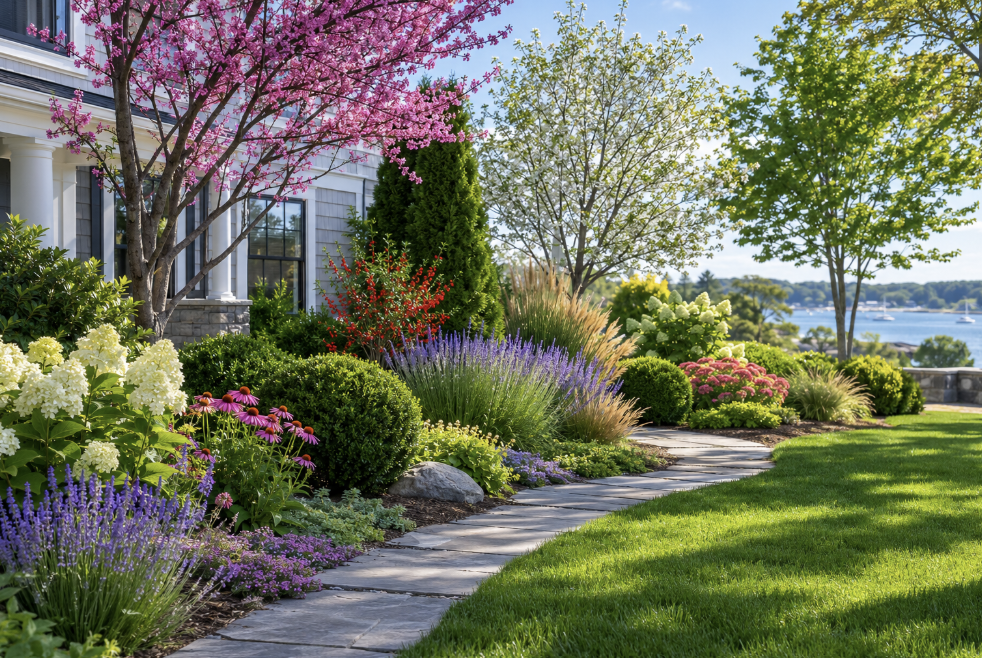
If you’ve ever watched a beautiful summer garden collapse into brown mush after the first hard frost, you already understand the core challenge of landscaping in cold climates: it’s not enough to plan for how a yard looks in July. In Massachusetts and across New England, a landscape has to survive nor’easters, salt spray, freeze-thaw cycles, and six-month stretches where the ground is either frozen or soaked. This guide walks through what actually works. From a plant selection to a design strategy so your investment holds up season after season, not just for one.
Table of Contents
- Why New England Demands a Different Approach
- Understanding Your Climate Zone
- Hardy Plants for Massachusetts Yards
- Designing for Coastal and South Shore Exposure
- Four-Season Design Strategy
- Hardscaping That Survives Freeze-Thaw Cycles
Why New England Demands a Different Approach
Landscaping in cold climates isn’t a stripped-down version of landscaping anywhere else — it’s a different discipline. Massachusetts sits at the intersection of continental cold snaps and Atlantic coastal weather, which means a single property can face wind exposure, road salt runoff, heavy wet snow load, and a growing season that’s noticeably shorter than what you’d find just a few states south.
A generic, big-box-store planting plan often fails here within two winters. Cold-resistant landscaping means designing from the ground up around three realities:
- Hard frost dates that arrive early and linger late (often mid-October through late April on the South Shore)
- Salt exposure from both winter road treatment and, for coastal towns, direct sea spray
- Freeze-thaw cycling, where repeated freezing and melting stresses soil, roots, and hardscape materials alike
Once you design around those three factors, plant choice, layout, and materials follows naturally.
Understanding Your Climate Zone
Most of Massachusetts falls into USDA Hardiness Zones 5b to 7a, though this varies meaningfully by proximity to the coast. Interior and western Massachusetts towns often sit in Zone 5, with colder minimum temperatures and a shorter growing window. Coastal and South Shore communities are benefiting from the moderating effect of the ocean frequently edge into Zone 6b or 7a, allowing for a slightly broader plant palette.
Knowing your specific zone matters more than most homeowners realize. A plant rated for Zone 7 may look fine in a nursery display in May and die completely by its second winter if planted in a Zone 5 pocket just twenty miles inland. This is the foundation of good region-specific plant selection always confirm your zone before finalizing a plant list, and account for microclimates on your own property (a south-facing wall holds heat; a low spot collects cold air and moisture).
Hardy Plants for Massachusetts Yards
Below are reliable categories for hardy plants for Massachusetts landscapes, chosen for their track record surviving harsh winters and inconsistent springs.
Trees:
- Eastern Redbud (Zone 4–8 hardy, spring color, tolerates part shade)
- American Hornbeam (extremely wind- and cold-tolerant, strong native option)
- Serviceberry (four-season interest spring flowers, summer fruit, fall color)
Shrubs:
- Inkberry Holly (evergreen structure, salt-tolerant, holds up well on exposed sites)
- Winterberry (deciduous holly with bright red winter berries a New England classic)
- Boxwood (reliable evergreen structure, though needs winter wind protection in exposed spots)
- Arborvitae (dense evergreen screening, cold-hardy to Zone 3)
Perennials & Grasses:
- Sedum (thrives in poor soil, drought- and cold-tolerant)
- Russian Sage (silvery foliage, handles wind and salt well)
- Little Bluestem and Switchgrass (native ornamental grasses that add winter texture and structure after other plants die back)
Groundcover:
- Creeping Thyme
- Pachysandra (shade-tolerant, evergreen, spreads reliably in New England conditions)
The common thread across this list: every plant here has a genuine track record in northern climate gardening, not just a hardiness zone rating on a tag. Zone ratings tell you the theoretical minimum temperature a plant survives. They don’t account for wind, salt, or wet feet in spring, which is often what actually kills marginal plants in this region.
Designing for Coastal and South Shore Exposure
South Shore properties Hingham, Cohasset, Duxbury, Marshfield, and similar coastal towns face landscaping challenges that inland Massachusetts yards don’t. Salt-laden wind can burn foliage on the windward side of a property, sandy soil drains too fast to hold nutrients, and storm surge or heavy rain can saturate low-lying beds.
Effective coastal design strategies include:
- Windbreak layering placing salt-tolerant shrubs like bayberry or beach plum on the exposed perimeter to shield more delicate plantings behind them
- Raised beds in low-lying or poorly draining areas, improving both drainage and root warmth
- Native dune and shoreline plants (beach grass, rugosa rose) where appropriate, which have evolved for exactly these conditions
- Salt-tolerant lawn alternatives, since traditional turf often struggles within direct salt-spray zones
This is where cold-resistant landscaping and coastal resilience overlap a plant that’s cold-hardy but salt-sensitive will still fail on an exposed South Shore lot, so both factors need to be screened for together.
Four-Season Design Strategy
A hallmark of strong New England garden design is that the landscape still looks intentional in January, not just June. This comes down to layering plants for structure across all four seasons:
- Spring: Early bloomers (redbud, forsythia) signal the shift out of winter
- Summer: Full foliage and flowering perennials carry the bulk of color
- Fall: Native shrubs and grasses (winterberry, switchgrass) provide color and movement as deciduous leaves drop
- Winter: Evergreen structure, bark interest (river birch, red-twig dogwood), and berries left standing for both visual interest and wildlife
Designing this way also means the “bones” of the landscape trees, evergreens, hardscape carry the property through the months when perennials are dormant, which is roughly half the year in this climate.
Hardscaping That Survives Freeze-Thaw Cycles
Plants aren’t the only thing tested by New England winters patios, walkways, and retaining walls take a beating too. Freeze-thaw cycling causes water trapped in small cracks to expand and contract repeatedly, which is the leading cause of cracked pavers, heaving walkways, and shifting walls in this region.
Practical safeguards:
- Proper base depth and compaction (a common failure point inadequate gravel base is the #1 cause of hardscape heaving in cold climates)
- Polymeric sand in paver joints, which resists washout better than standard sand
- Frost-depth footings for any retaining wall or structure, set below the local frost line (roughly 42–48 inches in much of Massachusetts)
- Materials rated for freeze-thaw durability dense natural stone and properly sealed concrete pavers generally outperform porous or untreated materials
Cutting corners here doesn’t show up in year one it shows up in year three, once several freeze-thaw cycles have had a chance to do their damage.
Working With a Local Landscape Professional
While a homeowner can absolutely select hardy plants and plan a layout independently, execution matters as much as plan proper drainage grading, frost-depth installation, and matching specific microclimates on your property to the right plant palette are easier to get right with local, hands-on experience. Firms rooted in this specific region, such as Land Design Associates in Walpole, work within Massachusetts and South Shore conditions regularly and can help translate a plant list into a landscape that’s actually built to hold up here. (Insert your firm’s specific services, project examples, or link here.)
Frequently Asked Questions
What is the best approach to landscaping in cold climates like New England?
The most reliable approach combines region-specific plant selection (matched to your exact hardiness zone and microclimate), four-season design so the yard has structure year-round, and frost-resistant hardscaping installed at proper depth to survive freeze-thaw cycling.
What are the hardiest plants for Massachusetts landscapes?
Inkberry holly, winterberry, arborvitae, serviceberry, and native ornamental grasses like little bluestem consistently perform well across Massachusetts hardiness zones, including exposed and coastal sites.
How does coastal exposure change landscape design in New England?
Coastal and South Shore properties need salt-tolerant plants, windbreak layering to protect more delicate plantings, and improved drainage since salt spray and sandy soil create stresses that inland Massachusetts landscapes don’t face.
Why do patios and walkways crack in cold New England climates?
Freeze-thaw cycling is usually the cause water trapped in the base or joints expands when it freezes, gradually shifting or cracking the surface. Proper base depth, compaction, and frost-depth footings prevent this.
When is the best time to plant in Massachusetts?
Early fall (September through early October) and mid-spring (after the last hard frost, typically late April to May) are the two best planting windows, giving roots time to establish before extreme heat or cold sets in.
Final Thoughts
Landscaping in cold climates rewards patience and the right information more than any other style of garden design. A Massachusetts or South Shore property planted with genuinely hardy, region-appropriate choices and hardscaped to withstand freeze-thaw stress won’t just survive one winter. It will look intentional and well-built for decades of them.
Start with a design consultation:
https://landdesignassociates.com/design-build-form/
Or explore our work here:
https://landdesignassociates.com/featured-projects/