

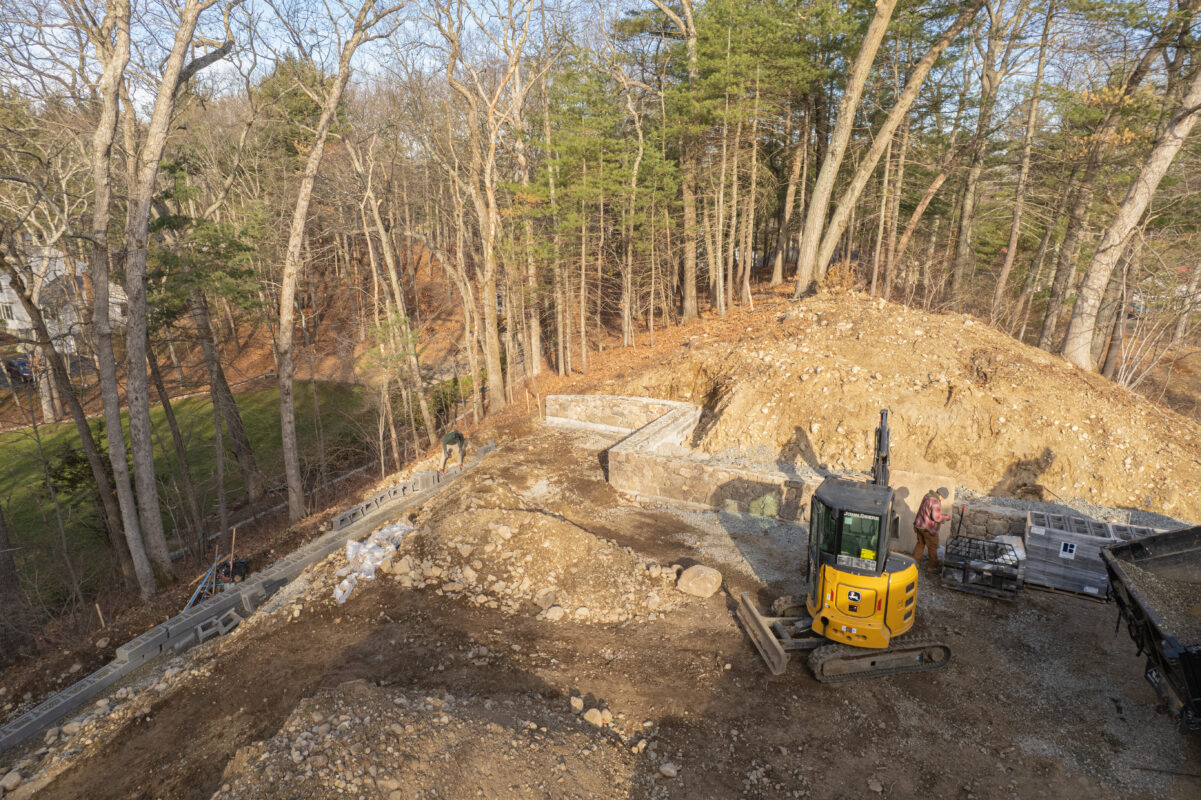
Land grading cost in Massachusetts typically runs $1.50–$5.00 per square foot for basic residential regrading, or $2,000–$30,000+ for a full lot, depending on slope, soil type, and drainage requirements. That range is wider than what national cost calculators show, because Massachusetts terrain — glacial till, ledge outcroppings, clay pockets, and inconsistent water tables — makes grading here fundamentally less predictable than grading a flat lot in the Midwest. If you’re budgeting off a national average, you’re likely underestimating.
What Drives Land Grading Costs in Massachusetts
Three factors move the price more than anything a contractor puts on a quote sheet: soil composition, slope severity, and drainage obligations. Much of eastern and central Massachusetts sits on glacial till — a mix of clay, sand, and buried rock — which means excavators frequently hit ledge (bedrock) a few feet down. Hitting ledge mid-job can add $3,000–$15,000 in blasting or hydraulic hammer work that wasn’t in the original estimate.
Slope matters just as much. A lot with less than a 5% grade is a straightforward regrade; anything over 15% typically requires retaining structures, terracing, or engineered drainage swales to meet local stormwater bylaws — most Massachusetts towns require a stormwater management plan for any grading disturbing more than 1 acre, and some require it at much smaller thresholds.
Land Grading Cost in Massachusetts by Project Type
| Project Type | Price Range | Notes |
|---|---|---|
| Minor regrading (drainage fix, small yard) | $1,500–$5,000 | No permit typically required under 1 acre disturbance |
| Standard residential lot grading | $5,000–$15,000 | New construction prep or major yard renovation |
| Sloped lot with retaining/drainage work | $15,000–$30,000 | Engineered swales, retaining walls, French drains |
| Full site development grading | $30,000–$75,000+ | New builds, subdivisions, or major additions requiring engineered plans |
These figures assume standard equipment access. Landlocked lots, tree-heavy sites, or lots requiring hand-grading near structures run 15–30% higher.
Land Grading Cost Per Acre
For larger properties, land grading cost per acre in Massachusetts generally falls between $1,500 and $5,000 per acre for basic clearing and rough grading, climbing to $8,000–$15,000 per acre when ledge removal, engineered drainage, or erosion control matting is required. Rural western Massachusetts lots with fewer wetland restrictions tend to price lower per acre than suburban Boston-area lots, where Conservation Commission review adds both time and engineering cost regardless of acreage.
Site Grading Contractors in Massachusetts: What to Ask
Not every excavation company is equipped to handle grading tied to a building permit or stormwater bylaw. Before hiring, confirm:
- Do they pull the grading/stormwater permit themselves, or is that on you?
- Have they worked with your town’s Conservation Commission if the lot is near wetlands or a buffer zone?
- Is soil testing included, or billed separately if unexpected conditions (ledge, high water table) are found?
- Do they carry erosion control (silt fence, hay bales, or engineered matting) as standard, or as an add-on?
A contractor who quotes grading without asking about wetland proximity or your town’s stormwater bylaw is quoting blind — that’s how a $6,000 estimate turns into a $14,000 change order mid-project.
Massachusetts-Specific Site Conditions That Change the Budget
Wetlands and buffer zones. Massachusetts Wetlands Protection Act buffer zones (typically 100 feet from any wetland, pond, or stream) trigger Conservation Commission review for grading work within that zone — adding $500–$3,000 in filing and engineering fees and 30–60 days to your timeline before work can start.
Frost and seasonal timing. Grading during winter months (typically December–March in most of the state) is possible but costs more due to frozen ground requiring additional equipment time, and some contractors won’t guarantee final grade accuracy until spring thaw settling is visible.
Drainage easements and neighboring property. Massachusetts follows a modified “reasonable use” rule for surface water — you can’t simply redirect drainage onto a neighbor’s property. Grading plans that alter water flow often require a drainage easement or engineered solution, which is a design cost, not just an excavation cost.
Ledge and buried debris. Older suburban lots — particularly in towns developed pre-1980 — sometimes have buried construction debris or old foundations that surface during grading, adding disposal costs that can’t be estimated in advance.
How to Budget Realistically
The single biggest mistake homeowners make is budgeting grading as a flat per-square-foot number without a contingency. Given how often Massachusetts sites hit ledge, high water tables, or wetland review, build in a 15–20% contingency on top of any quoted price — not because contractors are padding estimates, but because subsurface conditions here genuinely can’t be fully known until equipment is in the ground.
Frequently Asked Questions
How much does land grading cost in Massachusetts? Most residential grading projects in Massachusetts cost between $5,000 and $15,000, with minor regrading as low as $1,500 and full site development grading exceeding $30,000 depending on slope, soil, and drainage requirements.
What is the land grading cost per acre in Massachusetts? Basic grading runs $1,500–$5,000 per acre; sites requiring ledge removal or engineered drainage can run $8,000–$15,000 per acre.
Do I need a permit for land grading in Massachusetts? Grading disturbing more than 1 acre generally requires a stormwater management plan, and any work within 100 feet of a wetland requires Conservation Commission review regardless of acreage.
Why is land grading more expensive in Massachusetts than the national average? Glacial till soil, frequent bedrock (ledge), wetland buffer zone regulations, and stricter local stormwater bylaws add cost and complexity not present in flatter, less regulated regions.
Final Thought
Land grading cost in Massachusetts isn’t really a materials-and-labor calculation — it’s a regulatory and geological one. Homeowners who budget for soil testing, wetland review, and a contingency for ledge before signing a contract avoid the mid-project change orders that catch everyone else off guard.
Start with a design consultation:
https://landdesignassociates.com/design-build-form/
Or explore our work here:
https://landdesignassociates.com/featured-projects/