

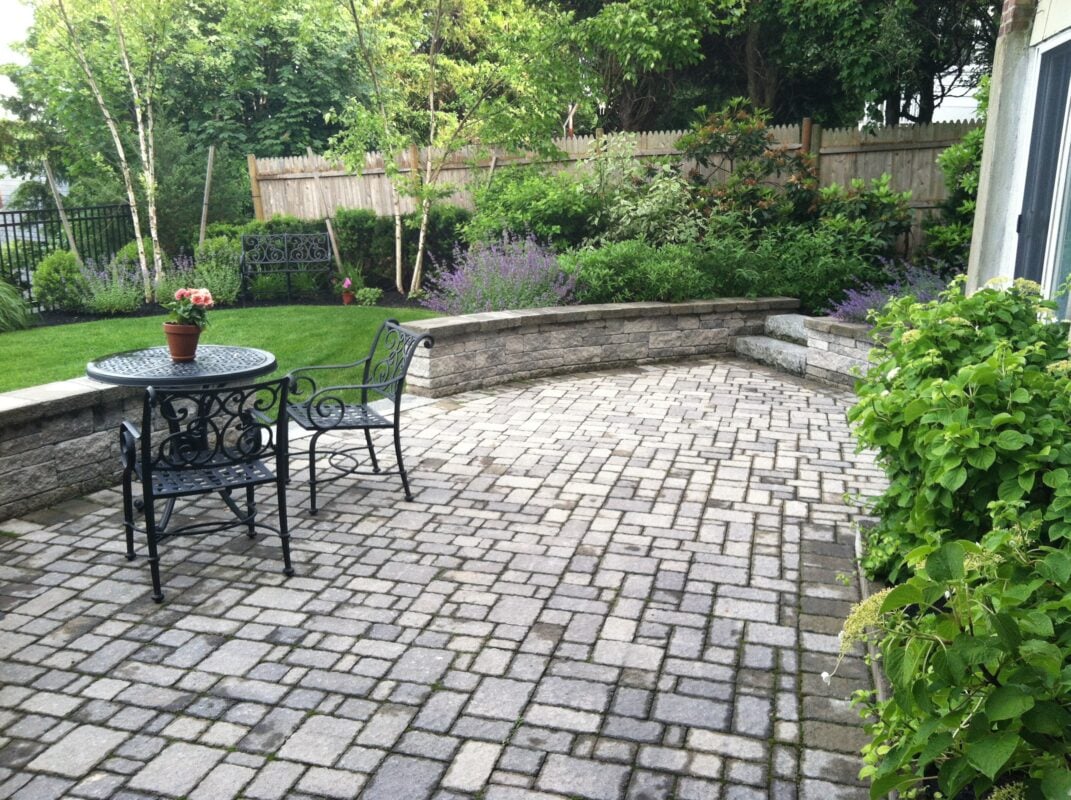
If you’re planning a new driveway, patio, or outdoor kitchen surround in Massachusetts, the paving material you choose isn’t just a design decision — in some towns, it’s a compliance decision. Permeable pavers cost more to install than standard asphalt or poured concrete, but they can also be the only option that satisfies local stormwater rules once you cross certain lot-coverage thresholds.
Here’s the direct answer, then the details: permeable paving typically costs 20–40% more than non-permeable paving per square foot, but it’s often required — not optional — once a property’s impervious surface coverage exceeds limits set by local conservation commissions or stormwater bylaws.
What “Permeable” Actually Means
Non-permeable (impervious) paving — standard asphalt, poured concrete, and traditional mortar-set pavers — creates a solid surface that water cannot pass through. Rain runs off into storm drains, ditches, or neighboring properties.
Permeable paving is engineered to let water pass through the surface and into the ground below. This isn’t just a different material on top — it’s a different system underneath. A permeable installation typically includes:
- Open-jointed pavers or porous concrete/asphalt
- A choker course of small aggregate
- A deep open-graded stone reservoir base (often 12–24 inches)
- In some designs, an underdrain tied into the site’s drainage plan
Water infiltrates through the surface, gets temporarily stored in the stone base, and either percolates into the soil or is slowly released — reducing peak runoff instead of eliminating it, but doing so in a way most local codes recognize as mitigation.
Cost Difference: What You’re Actually Paying For
The price gap isn’t in the paver unit cost alone — it’s in the excavation and base depth.
| Factor | Non-Permeable | Permeable |
|---|---|---|
| Excavation depth | 6–8 inches | 12–24 inches |
| Base material | Compacted gravel | Open-graded stone (larger, more expensive aggregate) |
| Installed cost (per sq ft) | $12–$20 | $17–$28 |
| Long-term maintenance | Sealing, crack repair, occasional replacement | Periodic vacuuming/jetting to prevent joint clogging |
| Lifespan | 15–25 years (asphalt), 25+ (concrete) | 20–30 years if maintained |
The upfront premium comes from moving more material out of the ground and bringing in more expensive aggregate to replace it. Maintenance costs run in the opposite direction over time — permeable systems don’t crack and heave the way asphalt does in New England’s freeze-thaw cycles, but they do require periodic cleaning to keep the joints from clogging with sediment, which restores infiltration capacity.
When Code Requires Permeable Paving — Not Just Suggests It
This is the part homeowners are most often surprised by. Massachusetts municipalities regulate impervious surface coverage through stormwater management bylaws, conservation commission review, and in some cases zoning overlay districts tied to wetlands or flood zones. The specifics vary town by town, so treat the following as the general pattern rather than a citation:
- Impervious coverage limits. Many towns cap the percentage of a lot that can be covered by non-permeable surfaces (house footprint, driveway, patio, walkways combined). Once a project pushes a property over that percentage, the remaining hardscape often has to be permeable to stay compliant — or the homeowner has to add separate stormwater mitigation (a dry well, rain garden, or detention system).
- Proximity to wetlands or water bodies. Properties within a conservation commission’s jurisdictional buffer zone frequently face stricter requirements, and permeable paving is a common condition of approval for driveway or patio work near these buffers.
- Redevelopment and additions. Adding a new impervious surface — like an outdoor kitchen slab or expanded driveway — can trigger stormwater review even on an existing lot that wasn’t previously regulated, especially if the added square footage crosses a town’s threshold (often somewhere in the 500–1,000 sq ft range, though this varies significantly).
- Site plan review for larger projects. Bigger hardscape projects may require a stormwater management plan showing how runoff is controlled, and permeable paving is one of the standard ways to demonstrate compliance without adding underground detention infrastructure.
The practical takeaway: before you finalize material choice, check your specific town’s stormwater bylaw and conservation commission requirements, or have your contractor pull the local regulations as part of the proposal. In some Massachusetts towns, this determination is made at the building permit stage — after the design is already set — which is the expensive way to find out permeable paving wasn’t optional.
Which Should You Choose If You Have a Choice?
If your project falls under any coverage threshold and permeable paving isn’t required, the decision comes down to site conditions and priorities:
Choose non-permeable if:
- Budget is the primary constraint and there’s no regulatory trigger
- The area sees heavy vehicle loads (permeable systems can be engineered for this, but it adds cost)
- You want the lowest-maintenance surface and are comfortable with periodic sealing
Choose permeable if:
- You’re near a wetland buffer or in a stormwater-sensitive area, even without a strict code requirement
- You want to reduce ice formation and runoff onto walkways in winter (permeable surfaces drain faster and pool less)
- You’re already investing in a freeze-resistant, insulated base for an outdoor kitchen or patio — the additional base depth for permeability adds less incremental cost than starting from scratch
Frequently Asked Questions
Does permeable paving still work in New England winters? Yes, when installed with proper base depth below the frost line. The open-graded stone base actually helps by allowing water to drain rather than pool and freeze on the surface, which reduces ice buildup compared to solid pavement.
Is permeable paving more expensive to maintain long-term? It requires different maintenance — periodic vacuuming or pressure-washing to keep joints from clogging — rather than more expensive maintenance overall. Skipping this maintenance is the main reason permeable systems fail early.
Can I install permeable pavers myself to save money? The paver placement is manageable for an experienced DIYer, but the excavation depth and stone base compaction require equipment and precision that most homeowners don’t have access to. An improperly compacted base is the most common cause of permeable paving failure.
How do I find out if my town requires permeable paving? Contact your local conservation commission or building department directly, or ask your landscape contractor to confirm impervious coverage limits before finalizing design. This is not information you want to discover after installation.
Considering permeable paving for a driveway, patio, or outdoor kitchen surround in Massachusetts? [Contact us] for a site evaluation that accounts for your town’s stormwater requirements before you finalize a design.
Start with a design consultation:
https://landdesignassociates.com/design-build-form/
Or explore our work here:
https://landdesignassociates.com/featured-projects/