

Native Plants Built to Thrive in Cohasset, Hingham & Duxbury — So You’re Not Constantly Replacing Things
By Land Design Associates, Inc. | Walpole, MA Landscape Architecture & Design for the South Shore of Massachusetts
If you’ve lived on the South Shore long enough, you know the story. You plant something beautiful in spring. By August it’s struggling. By the following May, it’s gone. You replace it. And the cycle repeats — costing you money, time, and more than a little frustration.
At Land Design Associates, we hear this from homeowners in Cohasset, Hingham, and Duxbury every season. And the solution, more often than not, isn’t trying a different vendor or a different variety of the same non-native plant. The solution is rooted — literally — in choosing plants that belong here.
This is one of the most important principles we apply as a professional landscape architecture firm serving the South Shore: when plants are matched to their environment, they perform. They don’t need constant coddling, replacement, or heavy inputs. They simply thrive — and your investment in your outdoor space pays off for years.
Here’s a practical guide to native plants specifically suited to the coastal, sandy, and wooded conditions found in Cohasset, Hingham, and Duxbury, Massachusetts — and why our landscape architectural design team recommends them for nearly every residential project in these communities.
Why Plant Selection Is a Landscape Architecture Decision, Not Just a Garden Center Choice
Many homeowners think of plant selection as a shopping decision. Walk in, pick what looks good, bring it home. But experienced landscape architects approach plant selection as a design and performance decision — one that accounts for soil composition, sun exposure, drainage, seasonal wind, salt tolerance, wildlife interaction, and long-term maintenance load.
On the South Shore, these factors are especially significant. Communities like Cohasset and Duxbury sit in close proximity to the coast, where salt air, sandy soils, and strong ocean winds create conditions that punish plants not adapted to handle them. Hingham, while slightly more protected, deals with its own mix of wooded lots, clay-heavy soils in some areas, and the same unforgiving New England freeze-thaw cycle.
Professional landscape architecture accounts for all of these variables before a single plant goes in the ground. And native plants — species that evolved over thousands of years in exactly these conditions — give any landscape design its best chance at long-term success.
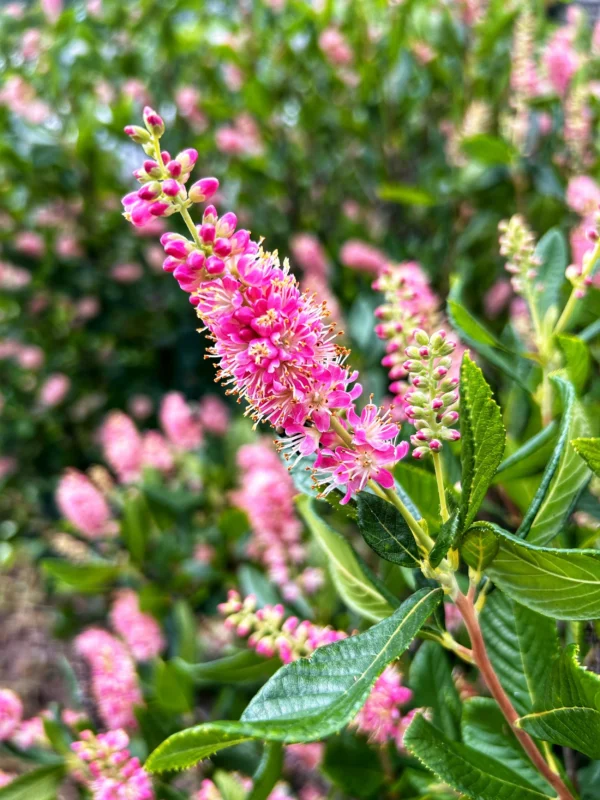
Ruby Spice Summersweet (Clethra alnifolia ‘Ruby Spice’)
Our #1 Recommended Native Shrub for the South Shore
If we had to pick one plant that exemplifies everything right about native plant selection for Cohasset, Hingham, and Duxbury landscapes, it would be Ruby Spice Summersweet.
This compact, upright shrub produces deep rose-pink, intensely fragrant flower spikes in mid-to-late summer — precisely when most other shrubs have finished blooming and your landscape needs visual interest. It typically reaches four to six feet tall and wide, making it ideal for foundation plantings, mixed shrub borders, or as a standalone specimen near an entry or patio.
Why it thrives here:
- Native to coastal New England — evolved for exactly this climate
- Tolerates salt spray, making it exceptional for properties in Cohasset and Duxbury near the water
- Thrives in moist to average soils, including the sandy loam common along the South Shore
- Handles part shade to full sun — versatile in wooded Hingham lots or open coastal settings
- Deer resistant and highly attractive to butterflies and bees
- Stunning fall color — foliage turns yellow to orange before dropping
From a landscape architectural standpoint, Ruby Spice earns its place not just because it survives, but because it performs beautifully through multiple seasons without demanding intervention. That is the hallmark of intelligent landscape design.
Inkberry Holly (Ilex glabra)
Inkberry is the native evergreen shrub that finally solves the “I want year-round screening that doesn’t die” problem so many South Shore homeowners face. Unlike many ornamental evergreens that struggle in wet or salty conditions, Inkberry is native to coastal Massachusetts and positively excels in low-lying, moisture-retaining soils.
It grows four to eight feet in height and produces small, dark berries that persist through winter — providing food for songbirds during the months when your landscape would otherwise feel barren.
For landscape architecture projects in Duxbury and Cohasset where privacy screening near wetland buffers or tidal influence zones is needed, Inkberry is often the most code-compliant, ecologically appropriate, and visually effective solution available.
Landscape architecture tip: Plant in masses of three or five for maximum visual impact and wildlife habitat value.
Bayberry (Morella caroliniensis)
Bayberry is one of the most ecologically and aesthetically valuable native shrubs in the South Shore palette — and it’s dramatically underused in residential landscape design. This rugged, semi-evergreen shrub is salt tolerant, drought tolerant once established, and positively thrives in the sandy, well-drained soils typical of Cohasset and Duxbury coastal properties.
The waxy gray berries that appear in fall are a critical food source for yellow-rumped warblers and other migratory birds. The aromatic foliage is attractive from spring through late fall. And unlike many ornamental shrubs, Bayberry doesn’t ask much once it’s established — no regular irrigation, no fertilization, no drama.
For landscape architects designing coastal estates in Cohasset or naturalistic border plantings in Duxbury, Bayberry fills a role that no non-native plant does quite as well: tough, attractive, wildlife-friendly, and deeply connected to the region’s natural character.
Winterberry Holly (Ilex verticillata)
If there’s one native plant that earns gasps from visitors to South Shore properties in December, it’s Winterberry Holly. This deciduous native holly drops its leaves in fall to reveal dense clusters of brilliant red berries that persist well into winter — creating one of the most striking landscape features possible during the months when most plants offer little to nothing visually.
Winterberry is native to wetland edges throughout Massachusetts and thrives in the moist, sometimes wet soils found on many Hingham and Duxbury properties. It requires both male and female plants to produce fruit, which is something our landscape architecture team always accounts for at the design stage so clients get the full show every winter.
Beyond aesthetics, Winterberry supports more than 48 species of birds. In a well-designed South Shore landscape, it functions as a focal point, a wildlife hub, and a four-season performer.
Little Bluestem (Schizachyrium scoparium)
Grasses are among the most underutilized elements in residential landscape architectural design on the South Shore — and Little Bluestem is the native species we recommend most often. This upright, clump-forming grass grows two to four feet tall, features blue-green foliage through summer, then transforms into a stunning copper-red and silver in fall and winter.
It is exceptionally drought tolerant, thrives in sandy and infertile soils, and requires virtually no maintenance once established. For coastal properties in Cohasset and Duxbury where well-drained, sunny conditions prevail, Little Bluestem fills edges, slopes, and naturalistic borders with striking texture and movement that no traditional ornamental grass matches for regional suitability.
From a landscape architecture perspective, Little Bluestem also functions as a structural element — it holds hillsides, controls erosion, and defines spaces in the landscape without the maintenance overhead that traditional lawn or groundcover requires in these conditions.
New England Aster (Symphyotrichum novae-angliae)
Every thoughtfully designed South Shore landscape needs a plant that closes the season in style — and New England Aster does exactly that. This native perennial blooms brilliant purple-violet from September well into October, providing critical late-season nectar for monarch butterflies, bumblebees, and other pollinators preparing for migration or winter.
New England Aster grows three to five feet tall, tolerates a wide range of soil conditions from average to moist, and naturalizes beautifully in both formal and informal landscape design settings. It pairs exceptionally well with Little Bluestem and Winterberry in South Shore plantings, creating a layered native planting scheme that performs from early spring through winter.
In our landscape architectural work throughout Hingham, Cohasset, and Duxbury, we often use New England Aster as the anchor perennial in pollinator gardens and naturalistic borders where clients want color, wildlife value, and minimal maintenance in the same plant.
Black-Eyed Susan (Rudbeckia hirta)
Reliable, cheerful, and completely unfazed by New England summers, Black-Eyed Susan is the workhorse native perennial that belongs in nearly every residential landscape design on the South Shore. It blooms from July through September, tolerates drought and poor soils, and reseeds gently without becoming aggressive.
In landscape architecture projects where clients want color in challenging sunny, dry spots — along driveways, at the base of south-facing walls, or on dry slopes where irrigation is impractical — Black-Eyed Susan delivers season after season without replacement.
How Land Design Associates Integrates Native Plants Into Full-Service Landscape Architecture
Knowing which plants belong here is just the beginning. The real value of working with a professional landscape architecture firm is how those plants are integrated into a cohesive, thoughtfully designed outdoor environment.
At Land Design Associates, our landscape architectural design process for South Shore properties includes:
- Site analysis — evaluating soil, sun, drainage, salt exposure, and existing vegetation before any plant is specified
- Master planning — designing the entire property as a unified system so native plantings work in concert with hardscape, lawn areas, and architectural features
- Plant specification — selecting proven cultivars sourced from reputable local growers, sized appropriately for immediate impact
- Installation and aftercare — ensuring proper planting technique, mulching, and initial establishment support
- Ongoing maintenance — our South Shore maintenance teams understand native plant stewardship and manage these landscapes with the seasonal knowledge they require
Whether you’re designing a new landscape from scratch in Duxbury, renovating an existing property in Hingham, or adding native plantings to a coastal estate in Cohasset, our landscape architecture approach ensures that what goes in the ground is built to last.
Stop Replacing. Start Investing.
The plants in this guide share a common trait: they were designed by nature to succeed in exactly the conditions you’re working with on the South Shore. They don’t need to be babied, replaced every few years, or propped up with chemical inputs. They belong here — and when your landscape design reflects that, the results speak for themselves.
If you’re ready to build a South Shore landscape that thrives rather than struggles, we’d love to talk. Land Design Associates serves Cohasset, Hingham, Duxbury, Walpole, and surrounding communities throughout Metro Boston and the South Shore.
Schedule Your Landscape Design Consultation Today
If you are planning a project and need landscape design in Walpole, MA or landscape design in Hingham, Duxbury and Cohasset, MA, working with the right team makes all the difference.
Land Design Associates is ready to help you design and build an outdoor space that is functional, durable, and built around your lifestyle.
Start with a design consultation:
https://landdesignassociates.com/design-build-form/
Or explore our work here:
https://landdesignassociates.com/featured-projects/