

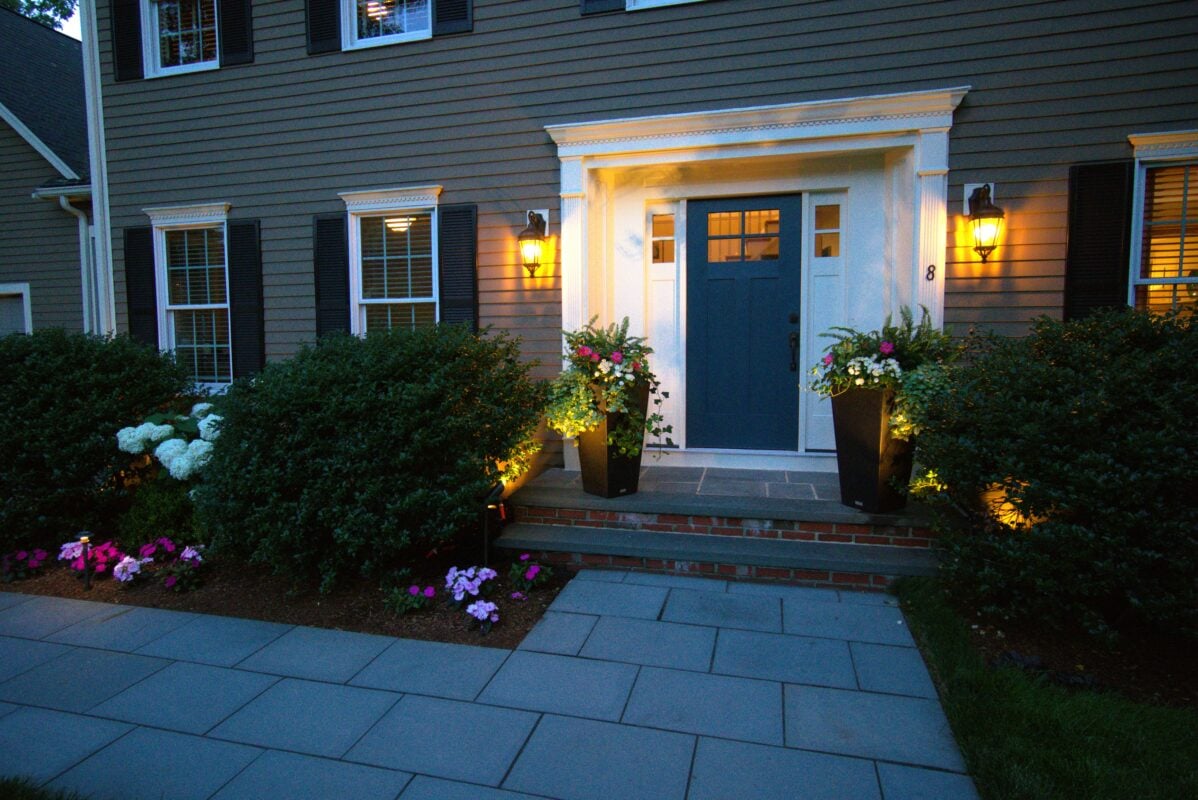
A great Massachusetts landscape follows seven core design rules: designing for all four seasons, matching plants to the region’s hardiness zones, planning for drainage, respecting local architectural character, balancing hardscape and softscape, designing for low-maintenance durability, and creating outdoor living spaces that extend the usable season.
Massachusetts is one of the more difficult places in the country to design a landscape well — and one of the most rewarding when it’s done right. Between clay-heavy soil in some towns, sandy coastal soil in others, harsh winters, humid summers, and a housing stock that ranges from 1700s colonials to modern coastal builds, a landscape plan that works in Georgia or California often fails here within a year or two.
At Land Design Associates, a professional landscape design firm based in Walpole, MA, we’ve spent years designing residential and commercial landscapes across Norfolk County, the South Shore, and greater eastern Massachusetts. Certain design principles come up on almost every project we take on, regardless of property size or budget. Below are the seven rules we consider non-negotiable for landscape design in Massachusetts.
These rules apply whether you’re planning a full front-yard renovation in Weymouth, a coastal backyard retreat in Duxbury, or a commercial property upgrade in Hanover. The details of each project will always be different — soil type, sun exposure, lot size, budget — but the underlying principles that separate a landscape that thrives for decades from one that struggles within a year or two stay remarkably consistent across the region.
Rule 1: Design for All Four Seasons, Not Just Summer
Rule 01
Massachusetts homeowners live with their landscape year-round, which means a plan built only for peak summer bloom will look empty for eight months of the year. A properly designed landscape layers in seasonal interest: spring bulbs and flowering trees, summer perennials and shade structure, fall foliage color from native trees and shrubs, and winter structure from evergreens, bark texture, and hardscape lines that hold up under snow.
This is especially important for front-yard and street-facing landscapes, which are seen from the road every day of the year, not just during a July barbecue.
In practice, this means every planting plan we draw up gets reviewed against a bloom and interest calendar, not just a plant list. We ask what the bed looks like in March, in August, and in December — because a landscape that only performs three months a year isn’t earning its cost. Evergreen structure, ornamental bark, seed heads left standing through winter, and berry-producing shrubs all contribute to a landscape that still has something to look at when the flowers are gone.
Rule 2: Match Plant Selection to Massachusetts Hardiness Zones
Rule 02
Most of Massachusetts falls within USDA Hardiness Zones 5b to 7a, though coastal areas along the South Shore often run slightly milder than inland towns. Plant selections that aren’t rated for these zones — or that are pushed to their absolute limit — tend to suffer winter dieback or fail outright after a hard freeze.
We prioritize native and climate-adapted species for the bulk of any planting plan: species like native viburnum, serviceberry, inkberry holly, and switchgrass perform reliably in Massachusetts conditions, require less irrigation once established, and support local pollinators. Ornamental or exotic specimens still have a place, but as accents — not the backbone of the design.
Microclimates also matter more in Massachusetts than most homeowners expect. A south-facing wall can create a warmer pocket that supports slightly less hardy plantings, while an exposed hilltop or a low spot that collects cold air can push effective conditions a full zone colder than the map suggests. Part of our job on any site visit is identifying these pockets before finalizing a plant palette, rather than relying on a generic zone rating alone.
Rule 3: Plan for Drainage and Grading Before Anything Else
Rule 03
Drainage is the single most overlooked element in DIY and budget landscape projects, and it’s the one that causes the most expensive problems later. Massachusetts properties deal with heavy seasonal rain, rapid spring snowmelt, and — in many towns — clay-heavy or poorly draining soil that holds water at the surface.
Before a single plant goes in the ground, a proper design accounts for grading away from the foundation, dry wells or French drains in low-lying areas, and permeable surfaces where appropriate. Skipping this step doesn’t just risk dead plants — it risks water in the basement.
We’ve been called in on more than one project where a homeowner installed a beautiful patio or planting bed, only to watch it flood or erode the following spring because grading wasn’t addressed first. Correcting drainage after hardscape is already in place is almost always more disruptive and more expensive than designing for it from day one — which is why it’s the first technical question we ask on every new site visit, before discussing style or plant choices at all.
Rule 4: Respect the Site’s Architecture and Local Character
Rule 04
Massachusetts has an unusually distinct architectural identity from town to town — colonial farmhouses inland, coastal shingle-style homes along the South Shore, dense Victorian streetscapes in older neighborhoods. A landscape design that ignores this context can look bolted-on rather than intentional.
Materials matter here: natural fieldstone and granite read as authentic in most New England settings, while stark modern materials can clash with a 1920s colonial unless handled deliberately. Good design pulls cues from the home’s rooflines, trim color, and existing hardscape rather than treating the yard as a blank canvas.
This principle extends to neighborhood context as well. A landscape that looks perfectly at home on a wooded, half-acre lot in Norwell might feel out of scale or out of character on a tighter, more formal Cohasset streetscape. We treat the surrounding neighborhood as part of the design brief, not just the individual property, since a home’s landscape is also part of a street’s overall character.
Rule 5: Balance Hardscape and Softscape for Real-World Function
Rule 05
A landscape that’s all planting beds and no usable surface doesn’t function for a family that wants to grill, entertain, or let kids play outside. A landscape that’s all patio and no greenery reads as cold and commercial. The right ratio depends on lot size and how the space will actually be used, but as a general rule, we look for enough hardscape to support real activity — patios, walkways, retaining walls, fire features — balanced against enough planting to soften edges and provide privacy.
This is also where a phased plan helps: hardscape is expensive to redo, so it should be designed first and correctly, even if planting is added or adjusted over several seasons.
A useful way to think about the split: hardscape defines how a family moves through and uses the yard, while softscape defines how it feels. Neither one should be an afterthought to the other. We often see the best results when hardscape and planting are designed together from the start, so walkways align naturally with sightlines, patios have shade and privacy planted around them, and the transition between “living space” and “garden” feels intentional rather than accidental.
Rule 6: Design for Massachusetts Winters, Not Just Massachusetts Summers
Rule 06
Freeze-thaw cycles, road salt, and snow load all take a toll on landscape materials that weren’t specified with New England winters in mind. Retaining walls need proper base preparation and drainage behind them or they’ll heave and crack after a few winters. Plantings near driveways and walkways need salt tolerance or a buffer zone. Hardscape joints and mortar need to be rated for freeze-thaw conditions, not just aesthetics.
Designing with winter in mind up front costs less than repairing storm and frost damage after the fact — a lesson many Massachusetts homeowners learn only after their first hard winter with a new landscape.
Snow storage is another detail that’s easy to overlook until the first big storm. Driveways, walkways, and parking areas all need somewhere for plowed or shoveled snow to go without burying plantings or blocking sightlines. We factor snow storage zones into the layout of hardscape and planting beds from the start, so the landscape still functions — and still looks intentional — in January, not just in June.
Rule 7: Create Outdoor Living Spaces That Extend the Season
Rule 07
New England’s outdoor season is short compared to warmer climates, which makes every extra usable week valuable. Fire features, covered pergolas, outdoor heaters, and wind-blocking plantings or fencing can meaningfully extend the number of comfortable evenings a family gets on their patio each year — often turning a three-month outdoor season into a six- or seven-month one.
These additions also tend to be some of the highest-return elements in a Massachusetts landscape design, since they directly increase how much use a family gets out of their outdoor investment.
We frequently recommend clients think of their outdoor living space the same way they’d think about an interior room addition: it should have a defined purpose, a sense of enclosure, and a reason to use it in shoulder-season months, not just at the height of summer. A well-placed fire feature or a partially covered dining area can turn October and even November evenings into usable time outside, well past when an open, unshaded patio would have been abandoned for the season.
Putting the Seven Rules Together
No single one of these rules works in isolation. A landscape that nails seasonal interest but ignores drainage will eventually flood. A landscape with the right plant hardiness zones but the wrong architectural character will look mismatched to the home. The strongest Massachusetts landscape designs treat all seven rules as one integrated plan from the very first site visit — which is the approach we bring to every residential and commercial project we take on.
Start with a design consultation:
https://landdesignassociates.com/design-build-form/
Or explore our work here:
https://landdesignassociates.com/featured-projects/