

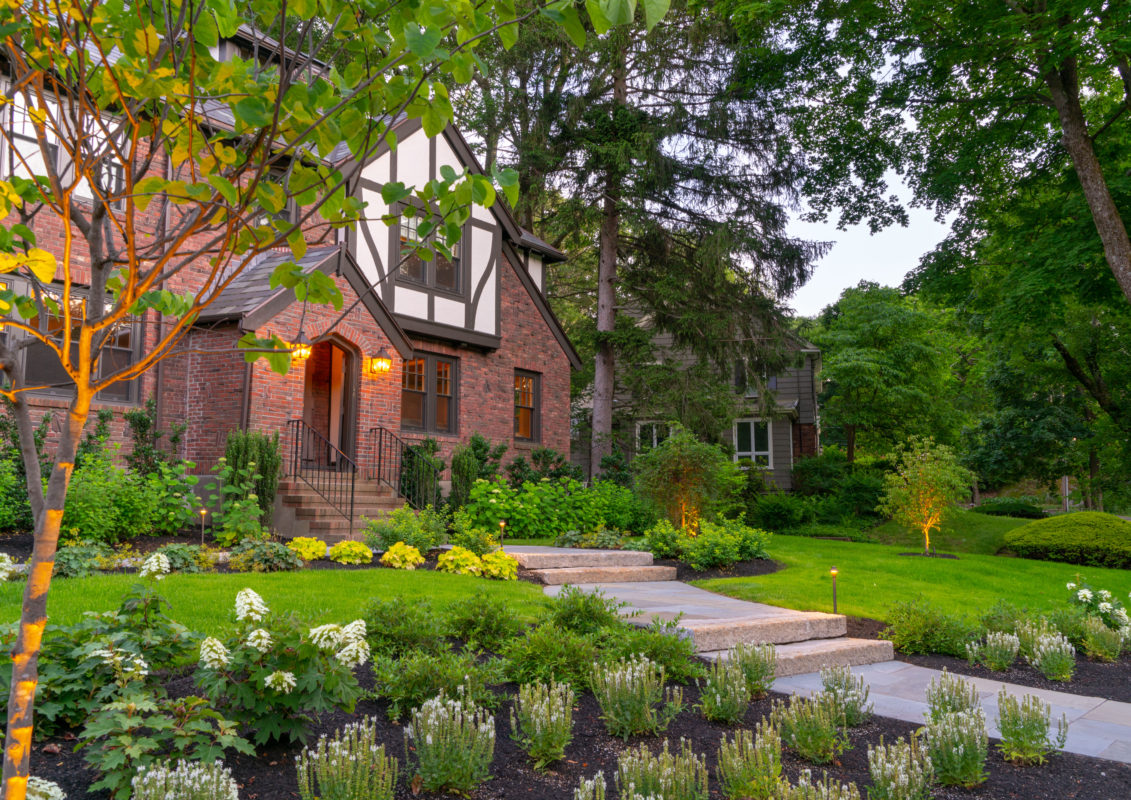
Landscape Installed by LDA in Newton. MA
If your home feels like it’s missing something—but you can’t quite put your finger on it—there’s a good chance the issue starts right at the foundation.
Foundation planting is one of the most overlooked (and most misunderstood) parts of residential landscape design. Done right, it softens architecture, frames your home, and creates a seamless transition between structure and landscape. Done wrong, it can make even a beautiful home feel crowded, dated, or unbalanced.
At Land Design Associates, we see the same mistakes over and over again across properties in the Greater Boston area. The good news? They’re all fixable—and avoidable.
Let’s break down the five most common foundation planting mistakes—and how to get it right.
1. Planting Too Close to the House
This is by far the most common issue we run into.
Homeowners (and even some contractors) install plants tight to the foundation, thinking smaller spacing creates a “full” look faster. The problem? Plants grow—and when they do, they crowd siding, trap moisture, and block airflow.
What happens over time:
- Shrubs press against siding and windows
- Poor air circulation can lead to mildew or rot
- Maintenance becomes a constant battle
What to do instead:
Plan for the mature size of the plant—not the size at installation. Proper spacing allows your landscape to grow into itself naturally without becoming overgrown.
2. Choosing the Wrong Plants for New England Conditions
Not all plants are created equal—especially in a region like New England, where we deal with cold winters, humid summers, and unpredictable transitions in between.
We often see foundation plantings filled with plants that:
- Struggle in USDA Zone 6b conditions
- Burn in full sun or fail in shade
- Require more maintenance than homeowners expect
What to do instead:
Select plants that are proven performers in this region. Native and climate-adapted species not only survive—they thrive with less intervention.
This is where professional design matters. Knowing how a plant behaves over time in our specific climate is the difference between a landscape that improves each year and one that constantly needs replacement.
3. Creating a Flat, One-Dimensional Look
Another common mistake is installing everything in a straight line at the same height.
This “row of shrubs” approach used to be popular—but today, it reads outdated and lacks visual interest.
What happens:
- No depth or layering
- No seasonal variation
- The home looks disconnected from the landscape
What to do instead:
Incorporate layers:
- Taller anchor plants for structure
- Mid-height shrubs for volume
- Lower plantings and perennials for detail and seasonal color
Good foundation planting should feel intentional and dynamic—not like a hedge running across the front of your house.
4. Ignoring Scale and Proportion
This is where things can really go sideways.
We’ve seen small homes overwhelmed by oversized plantings—and large homes that look underwhelming because the plantings are too small.
The issue:
Plants that don’t match the scale of the home throw off the entire composition.
What to do instead:
Design foundation plantings that complement the architecture—not compete with it.
- Larger homes need stronger plant masses to balance the structure
- Smaller homes benefit from more refined, scaled-down plant selections
This is one of the biggest advantages of working with a landscape designer—getting proportions right from the start.
5. Not Thinking About Year-Round Interest
In New England, your landscape isn’t just for summer—it needs to carry through all four seasons.
A common mistake is designing for a single moment (usually late spring or early summer) and ignoring what the planting looks like the rest of the year.
What happens:
- Winter landscapes feel empty
- Fall and early spring lack structure
- The property loses curb appeal for half the year
What to do instead:
Design for seasonality:
- Evergreens for winter structure
- Flowering shrubs for spring interest
- Perennials and ornamental grasses for summer and fall movement
A well-designed foundation planting should look intentional—even in February.
Why Foundation Planting Is More Than Just “Adding Shrubs”
This is where most people underestimate the value of professional design.
Foundation planting isn’t just about filling space—it’s about:
- Framing the home
- Managing scale and proportion
- Creating visual flow across the property
- Supporting drainage, grading, and long-term maintenance
When done right, it elevates the entire property.
When done wrong, it quietly detracts from everything else you’ve invested in.
Work With a Team That Gets It Right the First Time
At Land Design Associates, we take a full landscape architecture approach to foundation planting. That means we don’t just pick plants—we design systems that work together with your home, your property, and your lifestyle.
We consider:
- Sun and shade conditions
- Soil and drainage
- Long-term growth and maintenance
- How the planting integrates with the rest of your landscape
Whether you’re starting fresh or fixing an existing planting that’s outgrown its space, we can help you get it right.
Ready to Create a Cohesive Outdoor Living Space?
If you’re ready to transform your property into a thoughtfully designed outdoor environment, Land Design Associates, Inc. is here to help.
📍 Serving Walpole, MA & Cohasset, MA
📞 Contact us today to schedule a professional landscape design consultation.
Book a design consultation here https://landdesignassociates.com/design/
🌐 Portfolio: https://landdesignassociates.com/featured-projects/