

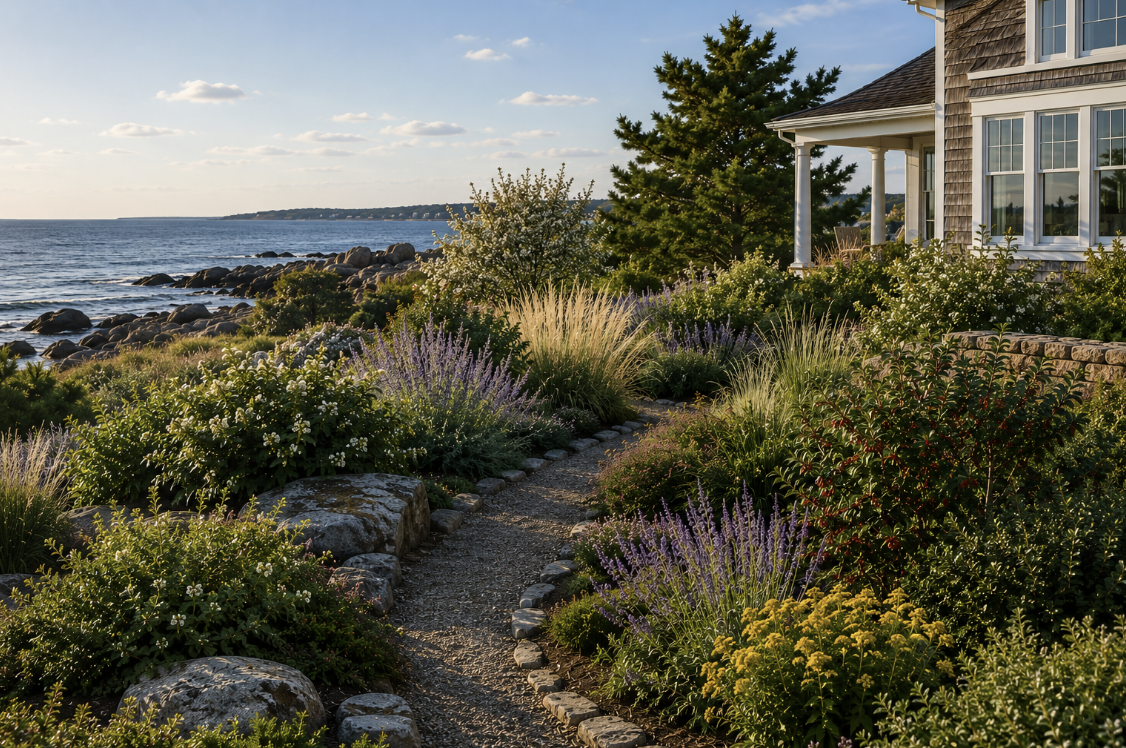
Coastal landscaping on the South Shore is equal parts opportunity and challenge. The same ocean breezes and water views that make Cohasset, Hingham, Duxbury, and Marshfield so beautiful also bring salt, wind, and demanding soils that punish the wrong plant choices. The good news: with the right plants and a design built for the coast, your landscape can look effortless year after year. This guide covers the salt-tolerant and native plants that actually thrive here, the design ideas that work in our climate, and the mistakes that cost South Shore homeowners the most.
What Makes Coastal Landscaping on the South Shore Different
Before choosing a single plant, it helps to understand the conditions your landscape has to survive. South Shore coastal properties face a specific combination of pressures:
- Salt spray and salt-laden wind. Near the water, salt settles on leaves and soil and quickly burns plants that aren’t adapted to it. The closer to the coast — and the more exposed the lot — the more salt-tolerant your plantings need to be.
- Wind and exposure. Open coastal and harborfront lots dry out faster, stress young plants, and call for windbreaks and sheltered planting pockets.
- Sandy and ledge soils. Much of Duxbury and Marshfield sits on fast-draining sandy soil, while Cohasset is known for granite ledge. Both affect what will grow and how you water it.
- Drainage and flooding. Coastal storms and heavy rain mean grading and drainage matter as much as the plants themselves, especially near the marshes and rivers of Marshfield and Duxbury.
- Deer pressure. Across the South Shore, deer-resistant plantings save a lot of heartbreak.
Get these conditions right and the planting choices below will reward you for decades. Ignore them, and even the most expensive landscape struggles.
The Best Salt-Tolerant Plants for South Shore Landscapes
These are the workhorses of coastal landscaping in our region — plants that handle salt, wind, and lean soils. Grouping them by type makes it easier to build a layered, resilient design.
Salt-tolerant trees and shrubs
- Northern bayberry (Morella pensylvanica) — A native coastal champion: tough, semi-evergreen, salt-tolerant, and excellent for informal hedging and screening.
- Beach plum (Prunus maritima) — A New England native that thrives in sandy coastal soil, with spring blossoms and edible late-summer fruit.
- Inkberry holly (Ilex glabra) — A native evergreen that handles salt and provides year-round structure and a tidy form.
- Eastern red cedar (Juniperus virginiana) — A salt-tolerant native evergreen that doubles as a natural windbreak.
- Shadbush / serviceberry (Amelanchier) — A graceful native small tree with spring flowers, berries, and strong fall color.
- Panicle and oakleaf hydrangeas — More wind- and exposure-tolerant than the classic bigleaf hydrangea, delivering that quintessential New England coastal look with better resilience.
- Winterberry (Ilex verticillata) — A native deciduous holly that tolerates wet ground and lights up winter with red berries.
Salt-tolerant perennials and ornamental grasses
- Switchgrass (Panicum virgatum) and little bluestem (Schizachyrium scoparium) — Native grasses that bring movement, four-season interest, and excellent salt and drought tolerance.
- Seaside goldenrod (Solidago sempervirens) — A native built for the coast, with late-season gold that supports pollinators.
- Daylilies, catmint, yarrow, and coneflower — Reliable, salt- and drought-tolerant perennials that fill beds with color and need little fuss.
- Russian sage and lavender — Silvery, fragrant, and well-suited to hot, sandy, well-drained coastal beds.
- Sedum (stonecrop) — Succulent, drought-proof, and dependable in lean soil.
Salt-tolerant groundcovers
- Bearberry (Arctostaphylos uva-ursi) — A native evergreen groundcover made for sandy, salty, sunny slopes.
- Creeping juniper — A tough, low, spreading evergreen that knits banks together and shrugs off salt and wind.
Why Native Plants Belong in Coastal Gardens
Many of the best coastal performers are New England natives, and that’s no coincidence. Native plants like bayberry, beach plum, little bluestem, and seaside goldenrod evolved in exactly these conditions — salt, sand, wind, and all. That adaptation translates into real advantages for homeowners:
- Less water and maintenance once established, because they’re suited to local soil and rainfall.
- Stronger resilience to salt, drought, and coastal weather.
- Support for pollinators and birds, keeping your landscape part of a healthy local ecosystem.
A thoughtful coastal design usually blends a backbone of natives with select ornamentals for color and form — giving you both beauty and durability.
Coastal Landscape Design Ideas That Work on the South Shore
Great coastal landscaping is about more than a good plant list. It’s about designing with the conditions rather than against them. These ideas consistently succeed on South Shore properties.
Build in windbreaks and sheltered pockets
Layered plantings — taller salt-tolerant trees and shrubs on the windward side, softer perennials tucked behind — create microclimates where a wider range of plants can flourish. Bayberry, red cedar, and inkberry make excellent natural screens.
Frame the view, don’t fight it
On waterfront and view properties in Cohasset and Scituate, the design should open up sightlines to the water while using grasses and low plantings to soften the foreground. The landscape becomes a frame for the view, not a wall in front of it.
Choose hardscape that handles salt and freeze-thaw
Natural stone, granite, and quality pavers stand up to coastal weather and the freeze-thaw cycle far better than budget materials. In Cohasset especially, working with the native granite character of the land produces patios and walls that feel rooted in place. Permeable paving also helps manage stormwater on tight or low-lying lots.
Design outdoor living around the wind
Patios, fire features, and dining areas should be positioned with prevailing wind in mind — sheltered by planting, a wall, or the house itself — so the spaces are usable on breezy coastal evenings.
Lean into a naturalistic, low-maintenance palette
Grasses, native shrubs, and drifts of tough perennials give that relaxed New England coastal feel while cutting maintenance. It’s a look that fits the South Shore and ages gracefully.
Designing for Drainage, Grading, and Coastal Weather
On the South Shore, what happens below the surface matters as much as what grows above it. Sandy soils drain fast and need plants suited to dry conditions, while low-lying lots near marshes and rivers need careful grading to move water away from the home. Coastal storms make this non-negotiable — a beautiful planting plan won’t survive standing water or eroding slopes. The best coastal designs solve drainage and grading first, then layer the plantings on top of a foundation that works.
Town Notes: Tailoring the Palette
Conditions shift from town to town, and so should the planting palette:
- Cohasset — Granite ledge and dramatic, exposed coastline reward rugged natives and stone-forward design that works with the rock.
- Hingham — More sheltered, historic neighborhoods allow a refined, classic palette, with hydrangeas and structured plantings that complement period homes.
- Duxbury — Sandy soils and big coastal lots suit naturalistic, drought-tolerant grasses and native shrubs.
- Marshfield — Proximity to the North and South Rivers and coastal flood zones puts drainage, grading, and salt-tolerant, water-friendly plantings front and center.
Common Coastal Landscaping Mistakes to Avoid
- Planting salt-sensitive species near the water. The single most common — and expensive — mistake. Match the plant to its exposure.
- Ignoring drainage and grading. Skipping this step undoes everything when the first big coastal storm arrives.
- Overwatering sandy soil. Fast-draining soil needs a different irrigation approach than inland clay; the wrong system wastes water and stresses plants.
- Planting invasives. Some old coastal standbys are now problematic, and several — including burning bush and Japanese barberry — are prohibited for sale in Massachusetts. A knowledgeable designer steers you toward better native alternatives.
- Forgetting the deer. Filling beds with deer candy guarantees frustration; resistant species save the design.
- Overlooking conservation rules. Planting or building near wetlands without checking local regulations can mean fines and do-overs.
Why Coastal Landscaping Is Worth Doing Right
A coastal landscape is one of the best investments you can make in a South Shore home — and one of the easiest to get wrong without local knowledge. The interplay of salt, soil, wind, drainage, deer, and conservation rules is genuinely complex, and the difference between a landscape that thrives and one that struggles usually comes down to experience with these exact conditions. That’s where working with a local design firm pays for itself.
Planning a coastal landscape on the South Shore?
Land Design Associates is a professional landscape design firm serving Cohasset, Hingham, Duxbury, Marshfield, and surrounding South Shore and Norfolk County communities. We design residential and commercial landscapes built for our coastal climate — choosing the right plants, solving drainage, and creating outdoor spaces made to last. Visit www.landdesignassociates.com to see our work and start a conversation about your property.
Frequently Asked Questions
What plants survive salt air on the South Shore?
Reliable salt-tolerant plants for coastal South Shore properties include northern bayberry, beach plum, inkberry holly, eastern red cedar, bearberry, switchgrass, little bluestem, seaside goldenrod, daylilies, catmint, and panicle hydrangeas. Native salt-tolerant species are the most dependable choice for properties close to the water in Cohasset, Duxbury, and Marshfield.
Are native plants better for coastal Massachusetts gardens?
Yes. Natives like bayberry, beach plum, little bluestem, and seaside goldenrod are adapted to South Shore soil, salt, and weather, so they need less water and maintenance once established and support local pollinators and birds.
When is the best time to plant on the South Shore?
Spring and early fall are the best planting windows. Fall planting lets roots establish in cool, moist soil before winter, while spring offers a full growing season. Avoid planting in peak summer heat or after the ground freezes.
Do I need a permit to landscape near wetlands in Massachusetts?
Often, yes. Work in or near wetlands, marshes, rivers, or coastal flood zones is regulated under the Massachusetts Wetlands Protection Act and reviewed by each town’s conservation commission. Many South Shore properties fall within these buffer areas, so confirm before planting, grading, or building near the water.
What are the best low-maintenance plants for a coastal South Shore yard?
Low-maintenance coastal choices include ornamental grasses like switchgrass and little bluestem, bayberry and inkberry shrubs, bearberry and creeping juniper groundcovers, and tough perennials such as daylilies, catmint, yarrow, and coneflower. Grouped by their light and moisture needs, these require little attention once established
Start with a design consultation:
https://landdesignassociates.com/design-build-form/
Or explore our work here:
https://landdesignassociates.com/featured-projects/