

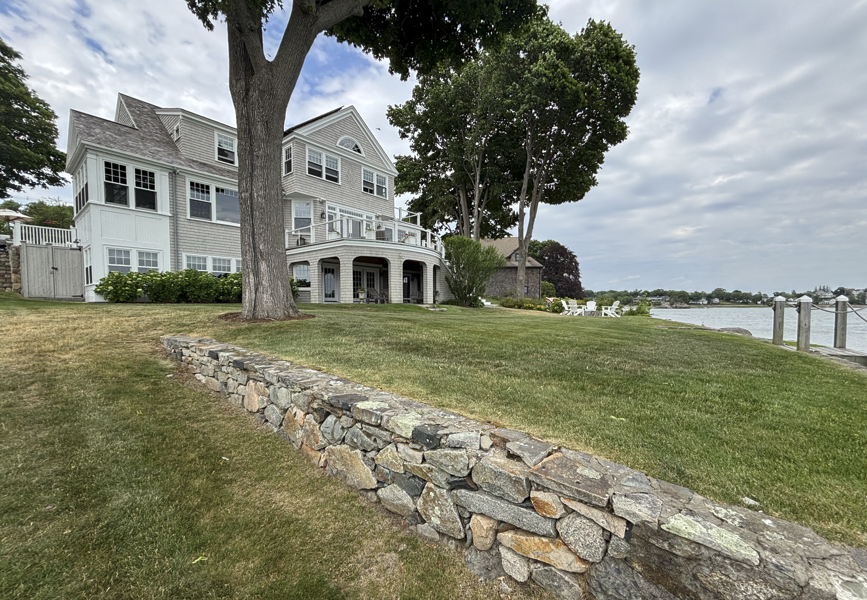
Every summer, the calls start coming in. A homeowner in Hingham notices their once-lush lawn fading to tan. A Cohasset family returns from a week at the Cape to find large brown patches spreading across the backyard. In Duxbury, a neighbor’s lawn looks perfectly green while yours looks like straw. What’s going on — and is your lawn dying?
In most cases, the answer is no. What you’re seeing is almost certainly turf dormancy — a natural, protective response that cool-season grasses use to survive summer heat and drought. Understanding what dormancy is, what triggers it, and how to manage your South Shore lawn through it can be the difference between a lawn that bounces back beautifully in September and one that needs costly repairs or reseeding.
At Land Design Associates, we help homeowners across Hingham, Cohasset, Duxbury, and the broader South Shore navigate exactly this question every summer. Here’s what you need to know.
What Is Lawn Dormancy — and Why Does It Happen?
Turf dormancy is a survival mechanism built into cool-season grasses — the type that makes up the majority of lawns across New England. When temperatures rise and rainfall falls short during the meteorological summer months of June, July, and August, these grasses face conditions that are fundamentally at odds with active growth.
Rather than struggle and die, they retreat. Growth slows, then stops. Shoots and roots die back. Green color fades to shades of tan, beige, and brown. From the outside, the lawn can look like it’s failing. But underground, the crown — the compressed stem at the base of each grass plant that serves as the main growing point — remains alive, holding enough moisture and carbohydrates to wait out the heat.
When temperatures cool and rain returns in late summer and fall, a healthy dormant lawn can recover fully, returning to green and resuming growth almost as if nothing happened.
The key variable that determines whether dormancy occurs is usually simple: irrigation. A lawn that receives regular supplemental watering through the summer will typically stay green. One that doesn’t will likely go dormant at some point, especially during extended dry stretches — which are a routine feature of South Shore summers.
Is a Dormant Lawn a Problem?
Not necessarily — and this is worth understanding clearly, because many homeowners make management decisions based on the assumption that brown equals bad.
Dormancy is a natural adaptation, not a failure. It’s how cool-season grasses have survived summer stress for millennia. A well-managed dormant lawn can provide reasonable ground cover, control erosion, and recover fully when conditions improve. In fact, intentionally “managing for dormancy” — letting the lawn go through its natural summer cycle without forcing it in or out with sporadic watering — is a perfectly legitimate and resource-efficient approach.
That said, dormancy does come with real trade-offs. Appearance suffers: a dormant lawn is brown, and it will stay brown until conditions moderate. Function can decrease: dormant turf is more susceptible to damage from foot traffic, compaction, and pest pressure. And recovery isn’t guaranteed to be perfect — extended or severe dormancy can deplete the resources the crown needs to spring back.
Whether dormancy is acceptable on your South Shore property depends on your expectations for how the lawn looks and performs, and whether sensitive areas or high-traffic surfaces are involved.
The Role of Grass Species: Not All Lawns Handle Dormancy the Same Way
One of the most important factors in how your lawn handles summer stress is what type of grass it contains. Different cool-season species handle heat and drought in very different ways — and this matters a lot for South Shore lawns in Hingham, Cohasset, and Duxbury, where salt air, variable soils, and summer heat all play a role.
Two distinct mechanisms are at work here:
Drought avoidance is the ability to delay dormancy — to keep growing and stay green longer as dry conditions develop. Tall fescue is the standout example: its exceptionally deep root system allows it to draw moisture from a much larger volume of soil than other grasses, helping it stay green longer when the surface dries out.
Drought tolerance is the ability to survive through extended dormancy and recover strongly afterward. The fine fescues — hard fescue, creeping red fescue, Chewings fescue — excel here. They may go dormant earlier than tall fescue, but their biology allows them to endure long dormant periods and emerge intact.
Grasses like Kentucky bluegrass and perennial ryegrass fall in the middle. Annual bluegrass and rough bluegrass are the most vulnerable, going dormant quickly and recovering poorly — a good argument for why weed control and overseeding with improved varieties matter for long-term lawn health.
If your South Shore lawn struggles every summer — going brown early and recovering slowly — the grass species composition may be part of the answer. This is something the team at Land Design Associates can evaluate and address through targeted overseeding programs.
Managing Dormancy Well: What to Do (and What to Avoid)
If you decide to let your lawn go dormant this summer — or if it goes dormant naturally before you’ve made a decision — here are the most important management principles to follow.
Commit fully — avoid half-measures
This is the single most important rule of managing for dormancy: don’t water sporadically. Irregular, insufficient irrigation during dormancy forces the grass to cycle in and out of active growth, burning through the carbohydrate reserves the crown needs to survive. Sporadic watering is often more damaging than no watering at all.
The right approach is binary: either commit to regular irrigation throughout the summer to keep the lawn actively growing, or let dormancy occur naturally and leave it alone. If you choose dormancy, the only exception supported by current research is a light “dormant irrigation” of no more than ½ inch of water every three to four weeks — just enough to keep crowns hydrated without triggering active growth.
Stop mowing unless the lawn is growing
The Rule of Thirds is a good guide here: never remove more than one-third of the grass blade in a single mowing. If the lawn isn’t growing, there’s nothing approaching that threshold — and mowing dormant turf only adds physical stress to an already-taxed plant. As we often say: if it isn’t growing, you shouldn’t be mowing.
Keep traffic off dormant areas
Dormant grass has reduced cushioning capacity and a compromised shoot system, which means foot traffic, equipment, and even pets crossing the lawn repeatedly can cause crown injury and long-term damage. Try to redirect activity away from dormant turf as much as possible through July and August.
Don’t fertilize dormant turf
Massachusetts law prohibits applying fertilizer to dormant, inactive, or brown turf — and there’s a good reason for that. Dormant root systems can’t absorb nutrients efficiently, meaning applied fertilizer is far more likely to leach into groundwater or run off into storm drains than to benefit your lawn. Hold off on fertilization until the lawn shows clear signs of active recovery.
One exception worth noting: a potassium application in spring, before summer stress arrives, can help strengthen stress tolerance and support recovery. And when fall recovery begins in earnest, a timely nitrogen application can accelerate the return to full density and color.
What to Expect from Recovery — and When to Consider Repairs
When temperatures cool and rain returns — typically in late August through September across Hingham, Cohasset, and Duxbury — a well-managed dormant lawn should begin recovering. Color returns gradually, growth resumes, and within a few weeks, most dormant lawns look largely normal.
But recovery isn’t guaranteed to be perfect. Extended dormancy depletes crown resources, and if conditions were severe, some areas may not recover fully. Thin spots, bare patches, and reduced density can all result from a challenging summer — especially in areas that experienced heavy traffic, pest pressure, or particularly poor drainage.
The good news: late summer and early fall are the best time of year for lawn repairs and overseeding in the cool-season environment. Soil temperatures are still warm enough for germination, air temperatures are cooler, and competition from summer weeds has subsided. If your lawn comes out of dormancy with areas that need attention, acting in September gives those repairs the best possible chance of success.
How Land Design Associates Can Help Your South Shore Lawn This Summer
Whether you’re committed to keeping your Hingham, Cohasset, or Duxbury lawn lush and green all summer or you’re comfortable managing for dormancy, the team at Land Design Associates can help you do it right.
We help clients evaluate their lawn composition, soil conditions, and irrigation setup to make informed decisions about summer management. We design and install efficient irrigation systems for homeowners who want to maintain active growth without wasting water. And for lawns that need recovery work in the fall, we offer overseeding, aeration, and renovation programs tailored to South Shore conditions.
The lawn is often the largest single landscape element on a property. Managing it well through summer — whether green or dormant — sets the foundation for a healthy, attractive outdoor space for the rest of the year.
Questions about your lawn this summer? We’re here to help.
📍 1415 Main Street, Walpole, MA 02081 📞 (781) 769-3286 🌐 landdesignassociates.com
Serving Hingham, Cohasset, Duxbury, and the South Shore.
Schedule Your Landscape Design Consultation Today
If you are planning a project and need landscape design in Walpole, MA or landscape design in Hingham, Duxbury and Cohasset, MA, working with the right team makes all the difference.
Land Design Associates is ready to help you design and build an outdoor space that is functional, durable, and built around your lifestyle.
Start with a design consultation:
https://landdesignassociates.com/design-build-form/
Or explore our work here:
https://landdesignassociates.com/featured-projects/