

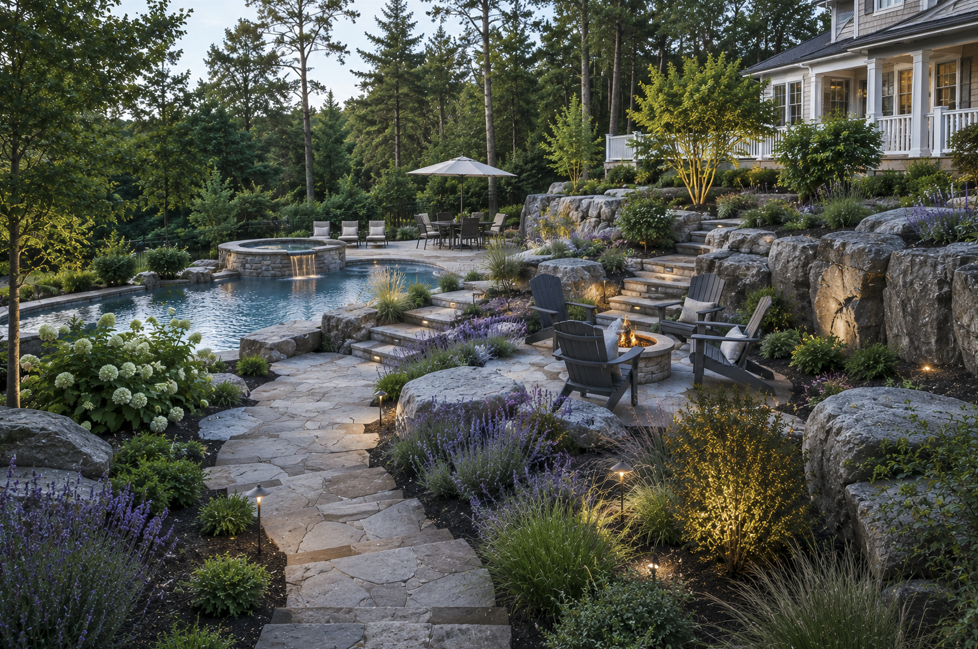
Designing outdoor environments that feel both intentional and effortless often begins with a willingness to listen to the land itself. In this Retreat in Wrentham, Massachusetts project, that philosophy shaped every aspect of the transformation. When a young family of five approached Land Design Associates with the goal of reimagining their backyard, they envisioned more than just a pool installation—they wanted a complete outdoor living environment capable of supporting large gatherings, active family use, and long-term enjoyment.
The site, however, presented a defining challenge and opportunity: a dramatic 20-foot granite ledge cliff rising from the rear of the property. With natural shelves, rugged outcroppings, and significant elevation changes, the ledge had the potential to either complicate construction or become the foundation of a truly unique landscape design. Through a thoughtful and site-responsive landscape architecture approach, the ledge was ultimately embraced as the central organizing element of the project.
Understanding the Site: Turning Constraints into Design Drivers
In many residential projects across Massachusetts, existing site conditions—particularly bedrock, ledge, and steep grades—can dictate both the feasibility and cost of construction. Rather than treating these conditions as obstacles requiring removal or concealment, this project illustrates how they can be leveraged to create a more authentic and enduring design.
The granite ledge in this Wrentham backyard was not only visually striking but structurally significant. Its natural terraces and protrusions offered opportunities for spatial organization that would have been difficult to replicate through artificial grading alone. Early site analysis focused on mapping elevations, identifying stable outcroppings, and understanding drainage patterns around the ledge. This allowed the design team to develop a layout that worked in harmony with the existing topography while minimizing disruption to the site.
By preserving the ledge and integrating it into the overall plan, the project avoided excessive blasting or removal—an important consideration in both cost control and environmental stewardship. This approach aligns with best practices in landscape architecture, where preserving natural features often results in more sustainable and visually compelling outcomes.
Pool Design: Integrating Form with Natural Geometry
At the center of the program was a swimming pool designed to accommodate an active family lifestyle. With three growing children, two dogs, and frequent entertaining, the pool needed to be generous in size while still feeling connected to the surrounding landscape.
A freeform pool layout was selected to reflect the irregular geometry of the ledge. Unlike rectilinear designs, which can feel imposed on complex terrain, the organic shape allows the pool to visually “fit” within the natural contours of the site. This approach is a hallmark of high-quality landscape design, where built elements respond to existing conditions rather than override them.
The pool’s edge treatment further reinforces this integration. Partial boulder coping—carefully selected to match the tone and texture of the native granite—creates a softened, transitional boundary between water and land. This detail reduces the visual contrast between hardscape and natural rock, helping the pool read as an extension of the environment rather than a standalone feature.
Layered plantings around the pool perimeter enhance this effect. By introducing a mix of perennials, ornamental grasses, and low shrubs, the design blurs edges and adds seasonal variation, making the pool area feel dynamic and immersive throughout the year.
Multi-Level Outdoor Living: Utilizing Natural Terracing
One of the most compelling aspects of this project is the use of the ledge’s natural elevations to organize outdoor spaces. Instead of creating a single, flat yard, the design embraces vertical variation to establish distinct functional zones.
Natural terraces within the ledge were adapted into a series of gathering areas, each offering a unique experience:
- Primary entertaining spaces adjacent to the pool provide room for larger groups, dining, and socializing.
- Intermediate seating areas take advantage of mid-level outcroppings, offering more intimate settings with views of the pool and surrounding landscape.
- Upper-level retreats create quiet, secluded corners for relaxation, reading, or conversation.
This layered approach enhances both usability and visual interest. From a landscape architecture perspective, it also improves circulation by creating a sequence of spaces that feel intuitive and connected, rather than disjointed.
Importantly, these spaces were formed with minimal alteration to the existing ledge. Strategic grading, selective placement of stone, and careful integration of pathways allowed the design to maintain a natural character while still achieving functional clarity.
Material Selection: Achieving Cohesion Through Local Stone
Material consistency was essential to the success of this project. Introducing new elements into a site dominated by natural granite required careful attention to color, texture, and scale.
To achieve a cohesive appearance, natural granite boulders were sourced from local Massachusetts quarries. These materials were selected specifically to match the existing ledge, ensuring that newly constructed features—such as retaining elements, steps, and seating areas—felt like a continuation of the site rather than an addition.
This approach reflects a core principle of professional landscape design: materials should reinforce the identity of the place. By using locally sourced stone, the project not only maintains visual harmony but also supports regional material practices and reduces transportation impacts.
Hardscape surfaces were chosen to complement the granite without competing with it. Subtle tones and natural finishes allow the ledge to remain the focal point, while still providing durable, functional surfaces for circulation and gathering.
Planting Strategy: Softening Structure and Enhancing Ecology
The planting design plays a critical role in balancing the ruggedness of the ledge with the comfort expected in a residential setting. Without vegetation, the vertical rock face could feel imposing. Through strategic planting, it becomes a dramatic yet inviting backdrop.
The planting palette was developed with several objectives:
- Softening vertical edges by introducing layered vegetation at the base and within crevices of the ledge.
- Creating visual transitions between hardscape and natural features.
- Providing seasonal interest through a mix of flowering perennials, grasses, and woody plants.
- Enhancing privacy in key areas of the yard.
Plants were selected for their adaptability to the site’s conditions, including well-drained soils near the ledge and full sun exposure in open areas. This ensures long-term success with minimal maintenance—a critical consideration for homeowners.
From a broader landscape architecture standpoint, the planting design also contributes to ecological performance. Increased vegetation supports pollinators, improves stormwater infiltration, and reduces heat buildup in hardscape areas.
Lighting Design: Extending Use into the Evening
Outdoor lighting was integrated to enhance both functionality and atmosphere. Rather than relying on high-intensity fixtures, the design emphasizes subtle, layered illumination.
Key lighting strategies include:
- Uplighting of specimen plants and rock features, highlighting texture and depth within the ledge.
- Pathway lighting to ensure safe movement between different elevations.
- Ambient lighting in gathering areas to support evening use without creating glare.
This restrained approach aligns with best practices in landscape design, where lighting should enhance the experience of space without overwhelming it. The result is an environment that transitions seamlessly from day to night, allowing the family to fully utilize their backyard after sunset.
Program Integration: A Complete Outdoor Living Environment
Beyond the pool and seating areas, the project incorporates a range of features that support a variety of activities:
- A private fire pit area designed for year-round use, ideal for informal gatherings and family time.
- Open spaces for recreation and play, accommodating both children and pets.
- Flexible zones for entertaining, including cookouts and larger social events.
- Opportunities for outdoor media experiences, such as movie nights under the stars.
Each element was carefully positioned to take advantage of the site’s natural structure while maintaining clear relationships between spaces. This holistic approach is central to successful landscape architecture, where individual components are designed as part of an integrated system.
Long-Term Value: Designing for Growth and Change
A key consideration in this Wrentham project was longevity. With young children, the family’s needs will evolve over time. The design anticipates this by providing flexible spaces that can adapt to different uses as the children grow.
Durable materials, thoughtful grading, and resilient plant selections contribute to a landscape that will age gracefully. Maintenance requirements were also considered throughout the design process, ensuring that the space remains manageable for the homeowners.
For Land Design Associates, this reflects a broader commitment to creating landscapes that are not only visually compelling but also practical and sustainable over the long term.
Conclusion: A Site-Driven Approach to Landscape Design in Wrentham
This ledge-inspired backyard in Wrentham, Massachusetts demonstrates the power of site-responsive design. By embracing the existing granite ledge and integrating it into every aspect of the plan, the project transforms a challenging condition into its greatest asset.
Through a combination of thoughtful landscape design, expert landscape architecture, and careful material and planting selection, the space now functions as a cohesive outdoor retreat in Wrentham. It supports the full range of family activities—from daily relaxation to large gatherings—while maintaining a strong connection to the natural character of the site.
For homeowners in Massachusetts facing similar site conditions, this project highlights the value of working with experienced professionals who understand how to unlock the potential of the land. At its core, the success of this design lies in a simple principle: the best landscapes are not imposed—they are discovered.
Trust Land Design Associates for Expert Landscape Design in Massachusetts
Understanding how winter conditions affect plant health is an important part of professional landscape care. Snow is not just a sign of winter—it is a natural protective system that helps preserve the beauty, health, and longevity of your landscape.
If you have questions about winter landscape care, planting design, or planning a new outdoor space, Land Design Associates is here to help.
Ready to Create a Cohesive Outdoor Living Space?
If you’re ready to transform your property into a thoughtfully designed outdoor environment, Land Design Associates, Inc. is here to help.
📍 Serving Walpole, MA & Cohasset, MA
📞 Contact us today to schedule a professional landscape design consultation.
Book a design consultation here https://landdesignassociates.com/maintenance/
🌐 Portfolio: https://landdesignassociates.com/featured-projects/