

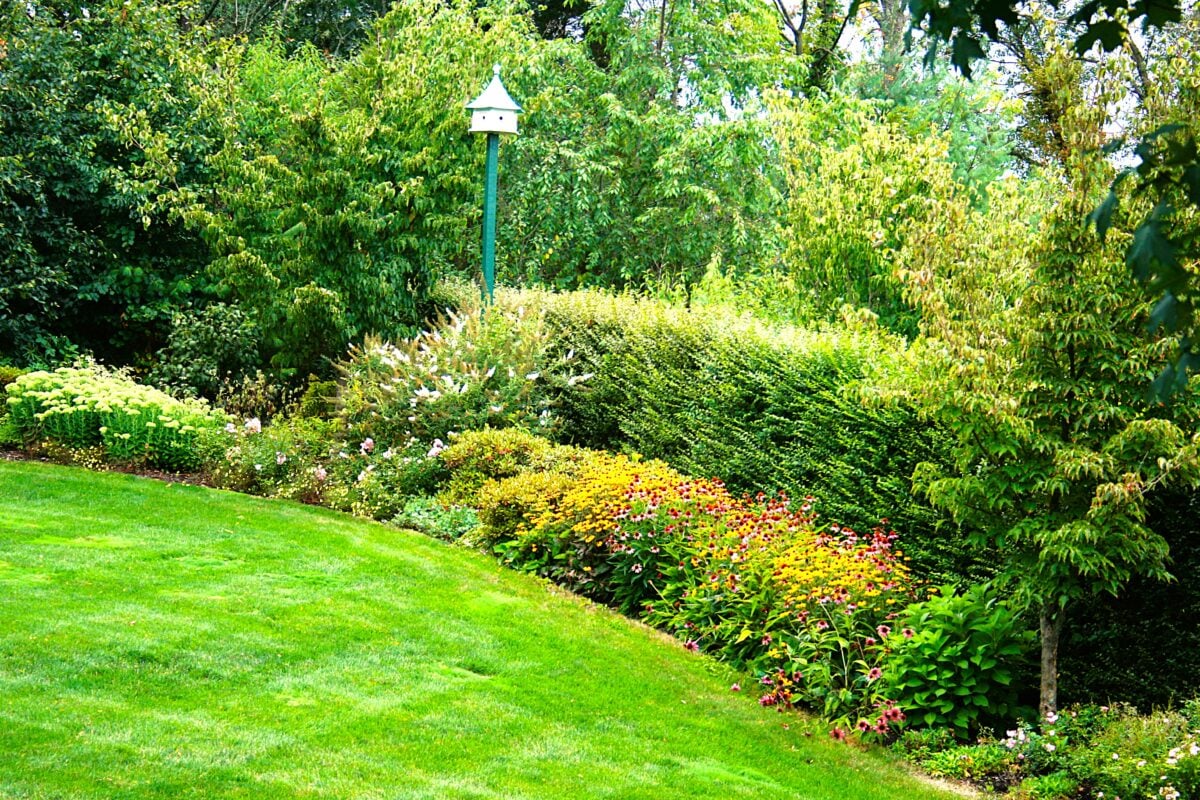
If your Massachusetts landscape needs constant watering, fertilizing, and replanting to look good, it isn’t working with the region — it’s working against it. Native New England plantings solve that problem at the root. As a professional landscape design firm serving Norfolk County, the South Shore, and greater eastern Massachusetts, Land Design Associates (LDA) has spent years designing landscapes that lean on native species to deliver year-round beauty with far less upkeep than the imported ornamentals many homeowners inherit with their properties.
This guide walks through why native plantings matter for Massachusetts homes, the specific species our design team reaches for most often, how we layer them into a finished landscape, and what homeowners across our service area — from Cohasset to Hingham to Duxbury — can expect in terms of cost and long-term care.
Why Native Plants Matter for Massachusetts Landscape Design
Native plants evolved alongside New England’s specific soil chemistry, rainfall patterns, and winter freeze-thaw cycles, which is exactly why they outperform non-native ornamentals once established. A native inkberry holly or little bluestem grass doesn’t need the irrigation, soil amendments, or pest control that a Mediterranean boxwood or a tropical-derived annual bed demands here.
Three practical benefits drive most of our clients’ interest in native design:
- Lower water bills and less irrigation infrastructure. Established native perennials and shrubs are adapted to typical Massachusetts rainfall and rarely need supplemental watering beyond their first one to two growing seasons.
- Fewer pest and disease problems. Native plants have co-evolved with local insect and fungal pressures, so they tend to shrug off issues that devastate non-native species planted outside their natural range.
- Real ecological value. Native plantings support pollinators, songbirds, and beneficial insects that depend on specific regional plant relationships — something a big-box nursery flat of petunias simply cannot replicate.
There’s also a design argument, not just an ecological one: native plants read as “of the place.” A landscape built from switchgrass, winterberry, and native oaks feels rooted in coastal Massachusetts in a way that imported boxwood hedges and Japanese maples, however lovely, do not.
The Best Native Plants for Massachusetts Landscapes
Our design team pulls from a fairly consistent palette across projects, adjusted for sun exposure, soil drainage, and each property’s architectural style. Here are the native species that perform best in our region.
Perennials and Ornamental Grasses
| Plant | Why We Use It |
|---|---|
| Black-Eyed Susan (Rudbeckia hirta) | Long summer bloom, thrives in full sun, tolerates poor soil |
| New England Aster (Symphyotrichum novae-angliae) | Critical late-season nectar source; extends bloom into October |
| Little Bluestem (Schizachyrium scoparium) | Copper-orange fall color, upright winter structure, drought-tolerant |
| Switchgrass (Panicum virgatum) | Strong vertical texture for borders and privacy screening |
| Wild Bergamot (Monarda fistulosa) | Pollinator magnet, fragrant foliage, tolerates coastal wind |
Shrubs
| Plant | Why We Use It |
|---|---|
| Winterberry Holly (Ilex verticillata) | Bright red berries persist into winter; thrives in damp soil |
| Inkberry Holly (Ilex glabra) | Evergreen, boxwood-like alternative that tolerates wet feet |
| Bayberry (Morella pensylvanica) | Salt- and wind-tolerant; ideal for South Shore coastal properties |
| Oakleaf Hydrangea (Hydrangea quercifolia) | Native hydrangea with strong fall color and winter bark interest |
Trees
| Plant | Why We Use It |
|---|---|
| Serviceberry (Amelanchier canadensis) | Spring flowers, edible summer berries, four-season interest |
| Red Maple (Acer rubrum) | Reliable fast growth and brilliant fall color; tolerates wet soil |
| Eastern Redbud (Cercis canadensis) | Early spring flowering, ideal as a specimen tree near entries |
Groundcovers
For sunny slopes and drainage-prone areas, we frequently specify native Pennsylvania sedge and creeping juniper, both of which stabilize soil, need no mowing, and out-compete weeds once established — a common concern on the sloped, ledge-heavy lots typical of Norfolk County and South Shore properties.
How LDA Designs With Native Plants
Native plants only look intentional when they’re designed, not scattered. Our design process treats them the same way we’d treat any specimen plant: with layering, seasonal sequencing, and a clear relationship to the hardscape.
- Site and soil assessment. We map sun exposure, drainage, and existing soil conditions before selecting species, since a plant that thrives in a wet swale will struggle on a dry, south-facing slope twenty feet away.
- Layered planting design. Trees anchor the composition, shrubs create mid-height structure and privacy, and perennials and grasses fill the front layer with color and movement.
- Four-season sequencing. We deliberately stagger bloom times — serviceberry in April, bergamot and coneflower in July, asters in September, winterberry into December — so the landscape never goes flat.
- Hardscape integration. Native plantings are set against patios, walkways, and retaining walls so the softscape softens hard edges rather than competing with them.
Featured Project: Native Plant Design in Hingham, MA
Hingham is one of the towns where native plant design has taken hold fastest among our clients, and it’s easy to see why. Hingham’s mix of historic waterfront properties, wooded inland lots, and strict local conservation guidelines around Weir River and Bare Cove make native, low-input landscaping both an aesthetic fit and a practical necessity.
On a recent Hingham project, our team replaced an aging, high-maintenance foundation planting of non-native boxwood and annual beds with a native palette built around inkberry holly, little bluestem, and New England aster, anchored by a serviceberry as the entry specimen tree. The result cut the client’s seasonal replanting and irrigation needs substantially while giving the property color and texture from April through the first hard frost — the kind of outcome that has made native design one of the most requested services from Hingham homeowners this year.
![[ALT TAG - see companion reference document]](https://www.claudeusercontent.com/%5BIMAGE:%20hingham-ma-native-landscape-design-lda-02.jpg%5D) Layered native shrub and perennial border completed by LDA for a Hingham, MA property near the waterfront.
Layered native shrub and perennial border completed by LDA for a Hingham, MA property near the waterfront.
Our Massachusetts Service Area
LDA is a professional landscape design firm based in Walpole, Massachusetts, and native plant design is available across our full residential and commercial service area, covering Norfolk County, the South Shore, and greater eastern Massachusetts.
- Walpole
- Cohasset
- Hingham
- Hull
- Duxbury
- Scituate
- Norwell
- Hanover
- Marshfield
- Weymouth
- Needham
- Newton
- Wellesley
- Westwood
- Weston
And surrounding Norfolk County and South Shore communities. If your town isn’t listed, reach out — LDA regularly takes on projects throughout greater eastern Massachusetts.
Native Plantings and Pollinator Gardens
A growing number of our Massachusetts clients specifically request pollinator-friendly design, and native plantings are the foundation of every one of those projects. Honeybees, native bees, and monarch butterflies rely on a sequence of native bloom to survive the season, and a landscape built entirely from hybridized, sterile ornamentals offers them almost nothing.
When a client asks us to design with pollinators in mind, we build around three anchor species: wild bergamot and coneflower for mid-summer nectar, New England aster for the critical late-season nectar push before frost, and native milkweed where space and sun allow, since it’s the only host plant monarch caterpillars can eat. We also avoid neonicotinoid-treated nursery stock, since treated plants can harm the very pollinators a garden is meant to support. The result is a landscape that does double duty: it looks intentional and layered from the street, and it functions as genuine habitat up close.
A Seasonal Maintenance Calendar for Native Landscapes
One of the most common questions we get from Norfolk County and South Shore clients is what ongoing care a native landscape actually requires. The honest answer is: less than a conventional landscape, but not none. Here’s the general rhythm we recommend.
| Season | What to Do |
|---|---|
| Early Spring | Cut back last year’s grasses and perennial stems before new growth emerges; top-dress beds with a light layer of compost. |
| Late Spring | Water new plantings weekly during dry stretches; established beds (year two-plus) rarely need supplemental irrigation. |
| Summer | Spot-weed as needed; native plantings out-compete most weeds once established, so this task shrinks year over year. |
| Fall | Leave seed heads and stems standing through winter — they provide bird food and habitat, and most native perennials don’t need fall cleanup. |
| Winter | Minimal intervention; evaluate structure and plan any additions or edits for spring installation. |
That “leave it standing” guidance in fall often surprises homeowners used to conventional landscape maintenance schedules, but it’s one of the clearest markers of a genuinely native-forward design: the landscape is allowed to look like itself through the winter months, rather than being cut back to bare mulch every October.
Cost and Maintenance: What to Expect
Native plant installations are typically priced comparably to conventional planting design — cost is driven more by plant size, quantity, and site preparation than by whether species are native. Where native design saves money is over time: most clients see a meaningful drop in irrigation, fertilizer, and pest-control spending starting in year two, once root systems are established.
The one trade-off worth setting expectations around: native perennial beds can look sparse in their first season while root systems establish below ground before top growth catches up. We build this into client conversations up front so a young native planting isn’t mistaken for an underperforming one.
Common Mistakes Homeowners Make With Native Plantings
- Treating “native” as a single plant palette. Massachusetts has enormous variation between coastal, wooded, and wetland-adjacent sites — a native plan for a Duxbury dune lot looks nothing like one for an inland Norwell property.
- Over-mulching and over-watering in year one. Native plants are adapted to lean conditions; excess water and mulch piled against stems invites rot.
- Skipping the layering. A row of the same native shrub isn’t a design — it’s a hedge. Layered heights and staggered bloom times are what make native landscapes read as intentional.
- Choosing plants for looks alone, without checking site conditions. A plant tag’s sun and moisture requirements matter as much as its bloom color; the wrong match is the single most common reason a new native planting fails in its first year.
- Expecting a finished look on day one. Native perennials invest early energy into root development rather than top growth, so a bed that looks sparse in June often fills in dramatically by August of the same season.
Frequently Asked Questions
What are the best native plants for Massachusetts landscaping?
The best native plants for Massachusetts landscaping include black-eyed Susan, New England aster, little bluestem grass, winterberry holly, inkberry holly, and serviceberry trees, all of which are adapted to local soil and climate conditions.
Are native plants really lower-maintenance than non-native plants?
Yes, established native plants generally require less water, fertilizer, and pest management than non-native ornamentals because they are already adapted to New England’s soil and climate.
Can native plants handle coastal, salty conditions on the South Shore?
Yes, species like bayberry, switchgrass, and little bluestem are naturally salt- and wind-tolerant, making them ideal for coastal properties in Cohasset, Hingham, Scituate, and Duxbury.
Do native plant gardens look messy or unkempt?
No, a professionally designed native garden uses the same layering and structure principles as any landscape design and looks intentional rather than wild when planned correctly.
How long does it take for a native landscape to fill in?
Most native perennial and shrub plantings reach a mature, filled-in appearance within two to three growing seasons as their root systems establish.
Does LDA design native landscapes for waterfront or conservation-restricted properties?
Yes, LDA regularly designs native, salt-tolerant landscapes for waterfront properties in Hingham, Cohasset, and Scituate that must meet local conservation-commission planting requirements.
Start with a design consultation:
https://landdesignassociates.com/design-build-form/
Or explore our work here:
https://landdesignassociates.com/featured-projects/